
Triumph Tiger 900 Alpine and Desert Editions, What South African Riders Need to Know
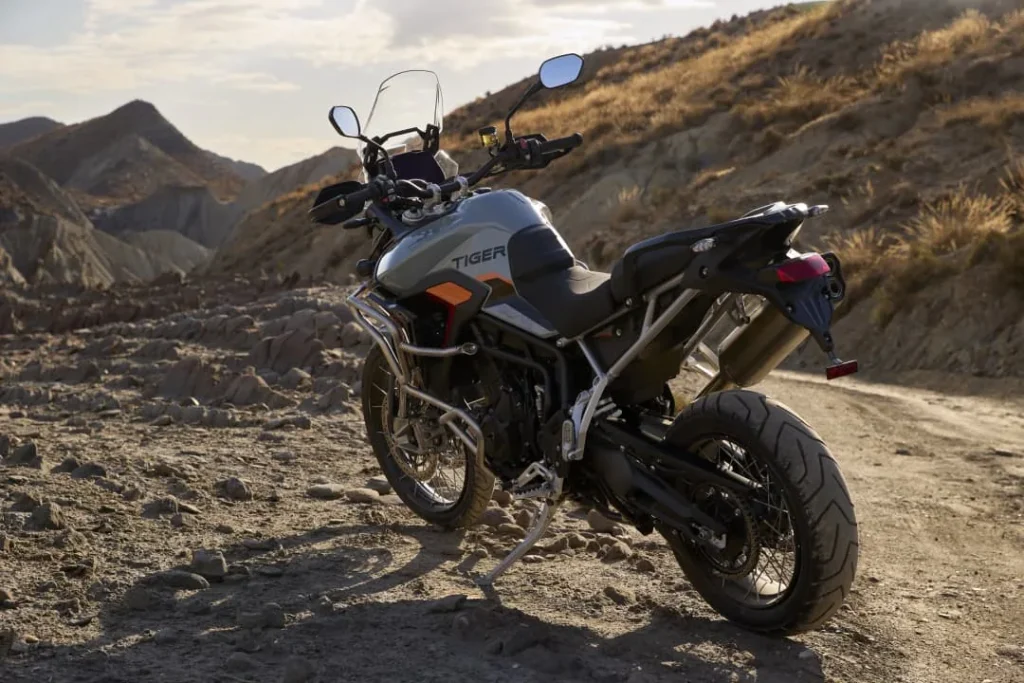
Triumph has put two new versions of the Tiger 900 into South African showrooms. The Triumph Tiger 900 Alpine Edition sells for R275,000 and the Desert Edition for R295,000 according to Triumph Motorcycles South Africa. Both carry an Akrapovic silencer as standard equipment, which Triumph has never done on an adventure Tiger before.
If you ride a 125 or a 400 and you are working out what comes next, these two bikes show you exactly how the ladder works in South Africa. They also show you how much bike your money buys once you leave the commuter class behind.
Here is what changed, what you get, and which of the two makes sense for the way you actually ride.
Pricing was checked against the Triumph Motorcycles South Africa model pages on 13 September 2026. Scooter125 is a listings marketplace, not a dealer, and neither bike was supplied for this article. Local pricing moves with the exchange rate, so confirm the figure with a dealer before you commit.
On this page
- What Triumph announced
- The engine both editions share
- Alpine Edition, the tar biased one
- Desert Edition, the gravel one
- Shared equipment
- Alpine or Desert, a straight comparison
- The seat height problem
- Where this fits if you ride something smaller
- What this means for the used market
- Should you buy one
- Frequently asked questions
What Triumph announced
Triumph revealed the Alpine and Desert Editions on 10 November 2025 and started deliveries in January 2026. The editions cover both the Tiger 900 and the larger Tiger 1200. This article deals with the 900, which is the volume seller in South Africa and the one that competes directly with the Honda XL750 Transalp, the Yamaha Tenere 700, the Suzuki V Strom 800DE and the BMW F 900 GS, the bikes you will find among the adventure and dual purpose bikes listed on Scooter125.
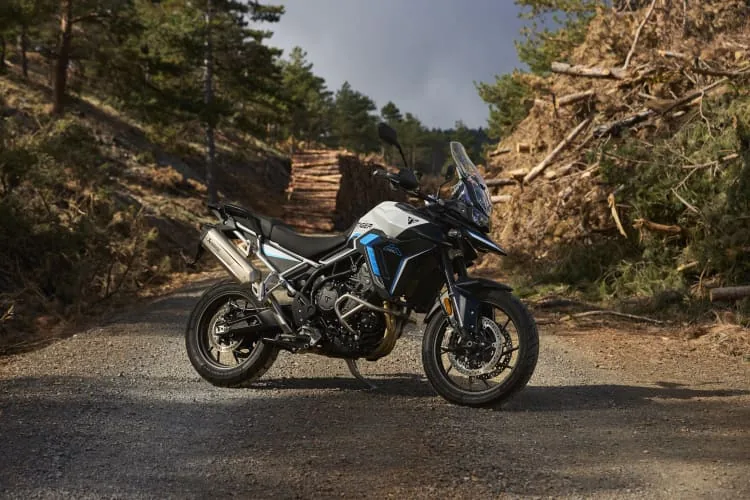
Paul Stroud, Chief Commercial Officer at Triumph, described the editions as bikes that carry “all the capability you’d expect from a Tiger with a distinctive and purposeful design, and enhanced specification” in the launch announcement.
The important detail sits underneath the paint. These are not new models. The Alpine Edition builds on the Tiger 900 GT Pro, which is the road focused version. The Desert Edition builds on the Tiger 900 Rally Pro, which is the version built for gravel and sand. Triumph took each of those bikes, added factory fitted kit that owners usually buy afterwards, and gave each one its own colour scheme.
Motorcycle.com confirmed with Triumph that the American price for each 900 edition sits 400 dollars above the standard Pro model it is based on. For that gap you get an Akrapovic exhaust and protection bars. Buy those two items separately and you spend a great deal more than 400 dollars.
The engine both editions share
Nothing changed mechanically. Both editions use the 888cc inline triple that Triumph calls the T plane, and it produces 108 PS at 9,500 rpm with 90 Nm of torque at 6,850 rpm.
The T plane firing order matters more than the peak numbers. Triumph spaced the ignition pulses unevenly, so the engine delivers drive in distinct pulses at low revs rather than the smooth surge of a conventional triple. On gravel that gives the rear tyre time to find grip between pulses. On tar it gives the bike a character closer to a twin without the vibration.
Triumph claims 4.7 litres per 100km. The tank holds 20 litres. Ride sensibly and you cover roughly 400km between fills, which puts most of the Karoo within reach on a single tank.
Both editions run Triumph Shift Assist, the up and down quickshifter, as standard. It is a different answer to the same traffic problem Honda is chasing with its E-Clutch technology: Triumph keeps the clutch lever for pulling away and lets you shift without it once rolling.
Alpine Edition, the tar biased one
The Alpine Edition wears Snowdonia White or Sapphire Black with Aegean Blue detailing. Full specification is on the Triumph South Africa Alpine Edition page.
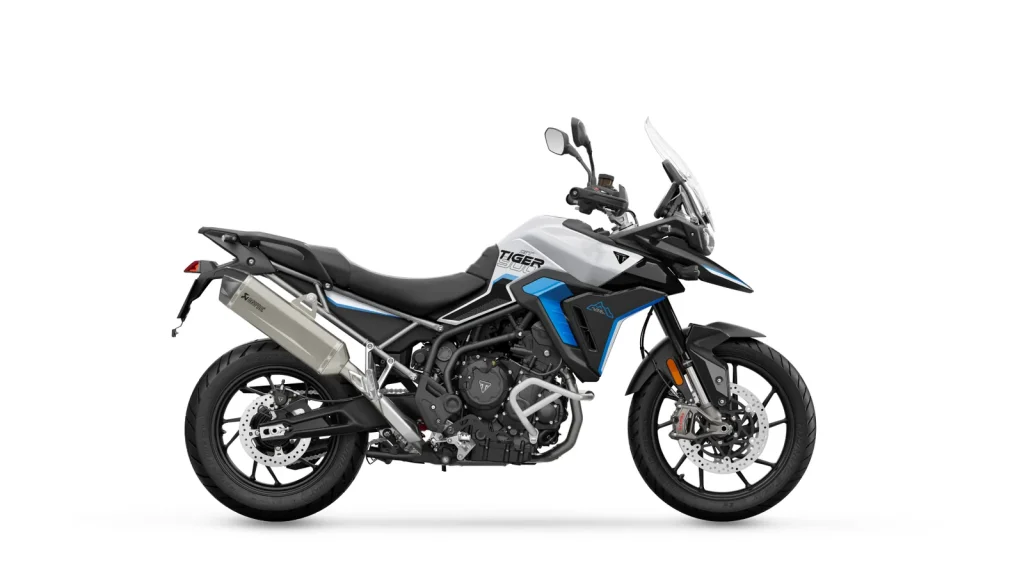
It runs Marzocchi 45mm upside down forks with 180mm of travel and an electronically adjustable Marzocchi shock with 170mm of travel. Wheels are 19 inch front and 17 inch rear, fitted with Metzeler Tourance Next tyres. Seat height adjusts between 820mm and 840mm. Wet weight is 224kg.
You get five riding modes, being Road, Rain, Sport, Off Road and Rider Configurable.
The extra kit over a standard GT Pro is the Akrapovic silencer with a titanium outer sleeve and carbon fibre end cap, plus engine protection bars.
This is the version for someone who commutes during the week, runs the N3 to the coast twice a year, and treats gravel as a shortcut rather than a destination.
Desert Edition, the gravel one
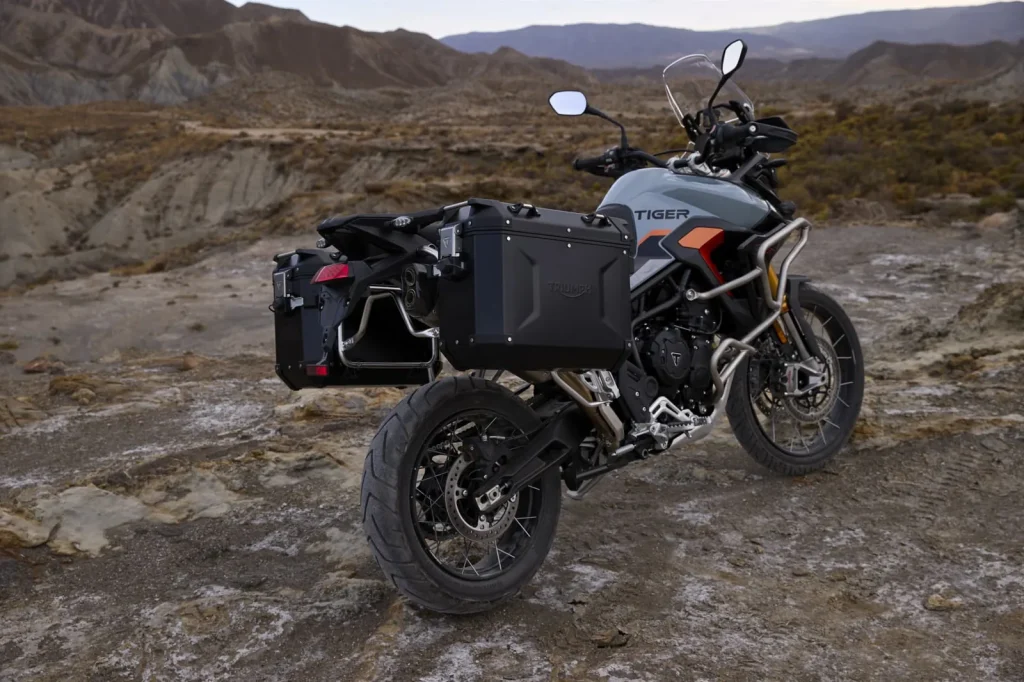
The Desert Edition wears Urban Grey or Sapphire Black with Baja Orange accents. Full specification is on the Triumph South Africa Desert Edition page.
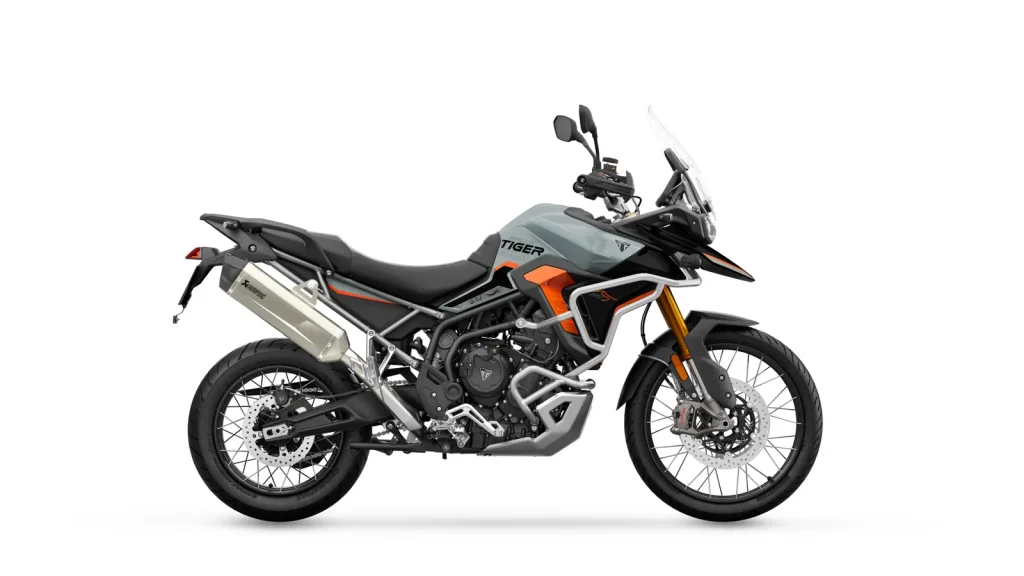
It runs Showa 45mm upside down forks with 240mm of travel and a Showa shock with 230mm of travel. That is 60mm more travel at each end than the Alpine. Wheels are 21 inch front and 17 inch rear, spoked and tubeless, fitted with Bridgestone Battlax Adventure tyres. Seat height adjusts between 860mm and 880mm. Wet weight is 231kg.
You get six riding modes, because the Desert adds Off Road Pro to the Alpine list. Off Road Pro switches off traction control and rear ABS completely and leaves the bike entirely in your hands.
The extra kit over a standard Rally Pro is the Akrapovic silencer plus fuel tank protection bars. An aluminium sump guard is standard.
This is the version for someone who rides to Sani Pass, not past it.
Shared equipment on both editions
Both bikes get Brembo Stylema monobloc calipers on twin 320mm front discs with cornering ABS, a 7 inch full colour TFT display with My Triumph Connectivity, all LED lighting, heated grips, cruise control, tyre pressure monitoring, handguards and an adjustable screen.
Triumph covers both with a two year unlimited mileage warranty. Service intervals fall at 12 months or 10,000km, whichever comes first.
Alpine or Desert, a straight comparison
| Specification | Alpine Edition | Desert Edition |
|---|---|---|
| Price in South Africa | R275,000 | R295,000 |
| Based on | Tiger 900 GT Pro | Tiger 900 Rally Pro |
| Engine | 888cc triple, 108 PS, 90 Nm | 888cc triple, 108 PS, 90 Nm |
| Front suspension | Marzocchi 45mm, 180mm travel | Showa 45mm, 240mm travel |
| Rear suspension | Marzocchi, 170mm travel | Showa, 230mm travel |
| Front wheel | 19 inch cast | 21 inch spoked tubeless |
| Tyres | Metzeler Tourance Next | Bridgestone Battlax Adventure |
| Seat height | 820mm to 840mm | 860mm to 880mm |
| Wet weight | 224kg | 231kg |
| Riding modes | Five | Six, including Off Road Pro |
| Protection bars | Engine | Fuel tank |
| Akrapovic silencer | Standard | Standard |
The R20,000 gap buys you suspension travel, a 21 inch front wheel, an extra riding mode and 40mm of extra seat height. If you weigh that up honestly and most of your riding happens on tar, the Alpine is the better buy and the lower seat will suit more riders.
The seat height problem nobody mentions
At 860mm to 880mm the Desert Edition is tall. A rider of average South African height will touch down on the balls of both feet at best, and loaded with luggage and a full tank that becomes a real consideration in a shopping centre parking area.
Triumph offers a low seat as a factory option on both editions, along with a heated seat. Ask your dealer to fit the low seat before you take delivery rather than after. Fitting it later means you own a seat you do not use.
Sit on both bikes before you decide. Sit on them with your riding boots on, because a thick sole changes the answer.
Where this fits if you ride something smaller
An 888cc Triumph is a long way from a 125cc commuter, and the gap is not only about money.
In South Africa a 125cc bike sits under an A1 licence. Anything above 125cc needs a code A licence, which means a full test on a bike over 125cc. Our guide to what a motorcycle licence costs in South Africa covers both codes. If you currently ride an A1 machine, a Tiger 900 is not a purchase decision until the licence is sorted.
The realistic ladder looks like this. You start on a 125 or a 150 for the commute. You move to something in the 250cc to 400cc bracket once the licence is done, which is where the Triumph Speed 400 and Scrambler 400 X live along with the Honda CB350 and the KTM 390 Adventure. From there the jump to a Tiger 900 stops feeling like a jump.
Skipping the middle step costs people money. A 231kg adventure bike punishes inexperience in gravel, and repairs on a Triumph are not commuter bike repairs. The plastics alone will change how you feel about a low speed drop.
What this means for the used market
Two things happen when a manufacturer adds factory fitted kit as standard.
The first is that the used value of the outgoing model softens. Buyers comparing a 2024 Rally Pro against a 2026 Desert Edition see a price gap that no longer covers the specification gap, so sellers adjust. That is good news if you are shopping used, and worth remembering when you browse used bikes for sale here.
The second is that owner fitted accessories stop adding value. A used GT Pro with an aftermarket exhaust and crash bars used to command a premium. Now those items are simply what the current bike has, so the premium disappears. Price a used bike on condition, service history and mileage, and treat bolt on extras as a convenience rather than a reason to pay more.
If you are selling a sub 500cc machine to fund a step up, the same logic applies in reverse. Standard bikes in clean condition with a full service book sell faster than modified ones.
Should you buy one
Buy the Alpine Edition if your riding is mostly tar with occasional gravel, you want a lower seat, and you would rather spend the R20,000 on luggage and a decent jacket.
Buy the Desert Edition if you ride gravel by choice, you are tall enough for it, and you want the 21 inch front wheel and the long travel Showa suspension that go with that.
Buy neither yet if your licence does not cover it, or if you have never ridden a heavy bike on loose surfaces. Spend a season on something in the 400cc class first. You will be a better rider on the Tiger for it, and you will have lost far less money finding that out.
Frequently asked questions
How much does the Triumph Tiger 900 Alpine Edition cost in South Africa?
Triumph Motorcycles South Africa lists the Tiger 900 Alpine Edition at R275,000. The Desert Edition lists at R295,000. Confirm current pricing with your dealer, because Triumph adjusts local pricing with exchange rates.
What is the difference between the Tiger 900 Alpine and Desert Editions?
The Alpine is based on the GT Pro and is set up for tar, with a 19 inch front wheel, Marzocchi suspension and 180mm of front travel. The Desert is based on the Rally Pro and is set up for gravel, with a 21 inch spoked front wheel, Showa suspension, 240mm of front travel and an extra Off Road Pro riding mode. The engine is identical.
Do the Alpine and Desert Editions replace the Tiger 900 GT Pro and Rally Pro?
No. Triumph sells them alongside the standard Pro models as higher specification versions rather than replacements.
Is the Akrapovic exhaust really standard?
Yes. Both editions ship with an Akrapovic silencer fitted from the factory, which is the first time Triumph has done this on an adventure Tiger.
What is the seat height of the Tiger 900 Desert Edition?
The seat adjusts between 860mm and 880mm. Triumph offers a low seat as a factory option, and a heated seat as an alternative.
What licence do I need to ride a Tiger 900 in South Africa?
A code A licence, which covers motorcycles above 125cc. An A1 licence only covers machines up to 125cc.
How far can a Tiger 900 travel on a tank?
The tank holds 20 litres and Triumph claims 4.7 litres per 100km, which works out to roughly 400km of usable range at a steady pace. Expect less if you ride hard or carry luggage into a headwind.
Sources
- Triumph Motorcycles South Africa, Tiger 900 Alpine Edition
- Triumph Motorcycles South Africa, Tiger 900 Desert Edition
- Triumph Motorcycles press release, Triumph Unveils Special Edition Tigers, 10 November 2025
- Motorcycle.com, 2026 Triumph Tiger 900 and 1200 Alpine and Desert Edition First Look
- Visordown, New Triumph Tiger 900 and Tiger 1200 Alpine and Desert Editions