
Buying advice
Buying used saves you money and transfers risk to you. These guides are about managing that trade. What to check before you hand over cash, what a service history is worth, how dealer and private purchases differ in protection, and which bikes make sense as a first one.
 Honda E-Clutch Explained and What the Rollout Means for South African Riders
Honda E-Clutch lets you ride without touching the clutch lever. Here is how it works, every model that has it, SA prices…
Honda E-Clutch Explained and What the Rollout Means for South African Riders
Honda E-Clutch lets you ride without touching the clutch lever. Here is how it works, every model that has it, SA prices…
 Suzuki Avenis 125 vs DS 250 SX, Which One Belongs In Your Garage
Suzuki Avenis 125 vs DS 250 SX compared for South African riders. Prices, specs, licence codes, running costs and which one suits…
Suzuki Avenis 125 vs DS 250 SX, Which One Belongs In Your Garage
Suzuki Avenis 125 vs DS 250 SX compared for South African riders. Prices, specs, licence codes, running costs and which one suits…
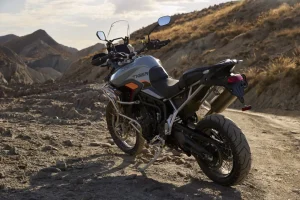 Triumph Tiger 900 Alpine and Desert Editions, What South African Riders Need to Know
Triumph Tiger 900 Alpine and Desert Editions are in South African dealers now. Full specs, R275,000 and R295,000 pricing, and who each…
Triumph Tiger 900 Alpine and Desert Editions, What South African Riders Need to Know
Triumph Tiger 900 Alpine and Desert Editions are in South African dealers now. Full specs, R275,000 and R295,000 pricing, and who each…
What you are actually trading
Buying used saves you money and moves the risk onto you. A new bike comes with a warranty and a dealer who has to care. A used bike comes with a price you can afford and whatever the last owner did to it. Managing that trade is the whole job.
Check before you pay
See the bike in daylight. Not at night, not in a garage, not in photographs. Colour hides in bad light and so does damage.
Start with the paperwork. The registration certificate must match the person selling it. If the name is different, ask why and stop if the answer is vague. Check the VIN stamped on the frame against the papers, character by character. A mismatch or a tampered stamp ends the conversation.
Then the bike. Cold start it yourself. A seller who has warmed the engine before you arrive may be hiding a hard start. Listen for rattles that settle after a minute, which usually means valve clearances, and rattles that do not, which usually mean money.
Look at the chain and sprockets. Hooked sprocket teeth and a chain you can pull away from the rear sprocket mean a set is due, which is fine if the price reflects it. Check tyre tread and the date codes on the sidewall, because tyres age out even without kilometres. Look at fork seals for weeping oil. Check that both brakes bite properly.
Sit on it and roll it forward. Grab the front brake and push down on the bars to feel the forks. Anything notchy in the steering means bearings.
Ride it
If the seller will not let you ride it, understand why before you accept the answer. Insurance is a reasonable reason. Nervousness about what you will find is not.
Get it into every gear. Check it does not jump out of second under load, which is a common wear point on small bikes ridden hard. Brake firmly from speed once. Listen for anything that appears only when the engine is warm.
What a service history is worth
A stamped book on a commuter is worth real money, and it is worth more than the same bike with 5 000km fewer and no record. Regular oil changes are almost the entire difference between a small engine that lasts and one that does not.
No book is not automatically a walk away, especially on cheaper bikes serviced at independent workshops. Ask who serviced it and phone them. A seller who can name the workshop is usually telling the truth.
Dealer against private
A private seller is cheaper. That is the appeal, and it is a real one.
A dealer costs more and gives you things the private sale does not. The Consumer Protection Act applies to a dealer, so there is an implied standard of quality. There is usually a limited warranty. The paperwork gets done properly. And there is somebody to phone in a month.
Neither is the right answer for everyone. If you can inspect a bike competently or bring someone who can, private saves you real money. If you cannot, the dealer premium is buying you insurance against your own inexperience, and that is a fair trade.
A sensible first bike
Something at or under 125cc so it fits an A1 licence. Something common, so parts are everywhere and any workshop knows it. Something you can flat foot at a robot. Something you will not cry about scratching, because you will scratch it.
Resale matters more than new buyers expect. Common commuter models from established brands hold value because there is always someone looking for one. An obscure import bought cheap is often impossible to sell at any price.
Paying
Never send money before you have seen the bike in person. Never pay a deposit to hold something you have not viewed. Meet in a public place during the day, and if a deal only works today, it is not a deal.