Suzuki SV-7GX (2027) Review, Specs and What It Means for South Africa

For 27 years the Suzuki SV650 has been the answer to the question “what should my first proper bike be?”. Its 645cc V-twin has been built more than half a million times, and most of the motorcycling world assumed emissions rules had finally killed it. They have not. Suzuki has reworked the engine with ride-by-wire throttle bodies, made it legal everywhere again, and dropped it into something new: the SV-7GX, a sport-touring crossover with a half fairing, an adjustable screen, a rear rack, a quickshifter and a 17.4 litre tank.
The first road tests are in from America, where it costs $8,599, and the verdict is consistent: a light, sweet-handling all-rounder with a lovely engine and budget suspension. Here is what the SV-7GX is, what the testers found, what it would cost to run in rand, and where it would fit in a South African Suzuki range that currently has a gap exactly this shape.
This is a research based review. Scooter125 has not ridden the SV-7GX and the bike was not supplied by Suzuki or a dealer. Specifications come from Suzuki’s global and United States model pages, and the riding impressions from first ride reviews by RevZilla’s Common Tread and TopSpeed. The running cost sums are our own at the projected October 2026 fuel price. Suzuki South Africa has not announced the SV-7GX or a price for it, so every rand figure for the bike itself is an estimate until a dealer gives you one in writing.
What you need to know first
The SV-7GX is a 645cc, 90 degree V-twin making 54 kW (72.4 hp) at 8,500 rpm and 64 Nm at 6,800 rpm, in a steel trellis frame, weighing 211 kg with a full tank. The seat is 795 mm from the ground. Despite the “7” in the name the capacity has not changed; the badge puts it in the same family as the GSX-S1000GX.
Standard equipment includes three riding modes, three-level traction control that can be switched off, a two-way quickshifter, a 4.2 inch TFT with phone connectivity, a USB-C port, full LED lighting, knuckle covers, a three-position windscreen and a rear carrier. There is no cruise control, and the suspension is non-adjustable apart from rear preload.
It is on sale in the United States at $8,599 and in the United Kingdom from £6,999. Suzuki South Africa’s website does not list it, and nothing has been announced locally. The closest thing in a local showroom is the V-Strom 650XT at R166,650, which uses the previous version of the same engine.
What the SV-7GX actually is

Suzuki calls it a crossover. In practice it is a road bike that splits the difference between the two machines that have carried this engine for two decades. It is more comfortable and better equipped than the naked SV650, and it is lower, lighter on its feet and sportier than the V-Strom 650. There is no pretence of off-road ability: 17 inch cast wheels at both ends, road tyres, 125 mm of fork travel and 135 mm of ground clearance.
The frame and engine come from the SV650. The fairing, the stacked projector headlight flanked by two LED position lights, the screen, the 740 mm tapered aluminium handlebar, the thicker one-piece seat and the moulded rear carrier with grab rails are new. So is the fuel tank, which grows to 17.4 litres.
RevZilla’s Lance Oliver parked his test bike next to a Kawasaki Versys 650, the obvious rival, and found the Suzuki “noticeably more compact” while offering similar wind protection. That is the pitch in one sentence: a sport-tourer that still feels like a middleweight naked when you thread it through traffic.
The 645cc V-twin, updated
The engine is the reason this bike exists. It is a liquid-cooled 90 degree V-twin with double overhead cams, four valves per cylinder, an 81.0 mm bore and a 62.6 mm stroke. What is new is the intake side: ride-by-wire control of new 39 mm electronic throttle bodies, with twin iridium plugs in each cylinder. That was what Suzuki needed to get the engine through current emissions rules, and a side benefit is that the throttle bodies synchronise themselves, which removes a job from the service schedule.
Compression is a modest 11.2 to 1 and Suzuki says the engine is happy on regular fuel, which in South African terms means 93 unleaded inland is fine. Claimed output is 54 kW at 8,500 rpm and 64 Nm at 6,800 rpm, with a 10,000 rpm redline.
Ride-by-wire conversions of old engines often go wrong, so both testers went looking for snatchy fuelling. Neither found any. Oliver reported no abruptness off idle and no peaks or dips, “just a predictable response across the rev range”. TopSpeed’s Nic de Sena praised the low-end and midrange punch and the V-twin character, noting only that it gets a little buzzy near the top. At 113 km/h in sixth the engine is turning 5,000 rpm, so 120 km/h sits at about 5,300 rpm, right in the meat of the torque.
The three modes are labelled A for Active, B for Basic and C for Comfort. A and B both give full power, with B softening the throttle response. C does something unusual for a Suzuki: it also caps peak power at about 45 kW (60 hp). That makes it a real rain mode, and a useful training mode for someone stepping up from a 300 or 400. Traction control is set separately from the mode, in three levels plus off, and both can be changed on the move.
Altitude takes its usual cut. On the Highveld expect roughly 46 kW at the crank. A V-twin with this much midrange hides the loss better than most, and 46 kW in a 211 kg bike is still a comfortable 140 km/h cruiser with overtaking in hand.
The quickshifter works in both directions. Both reviews rated the upshifts and were less convinced by the downshifts, which Oliver found inconsistent and de Sena called clunky because of the V-twin’s strong engine braking. Both ended up using the clutch on the way down. The clutch itself is Suzuki’s assist type, and Low RPM Assist raises the idle slightly as you pull away, which makes it very hard to stall.
Chassis, brakes and how it rides
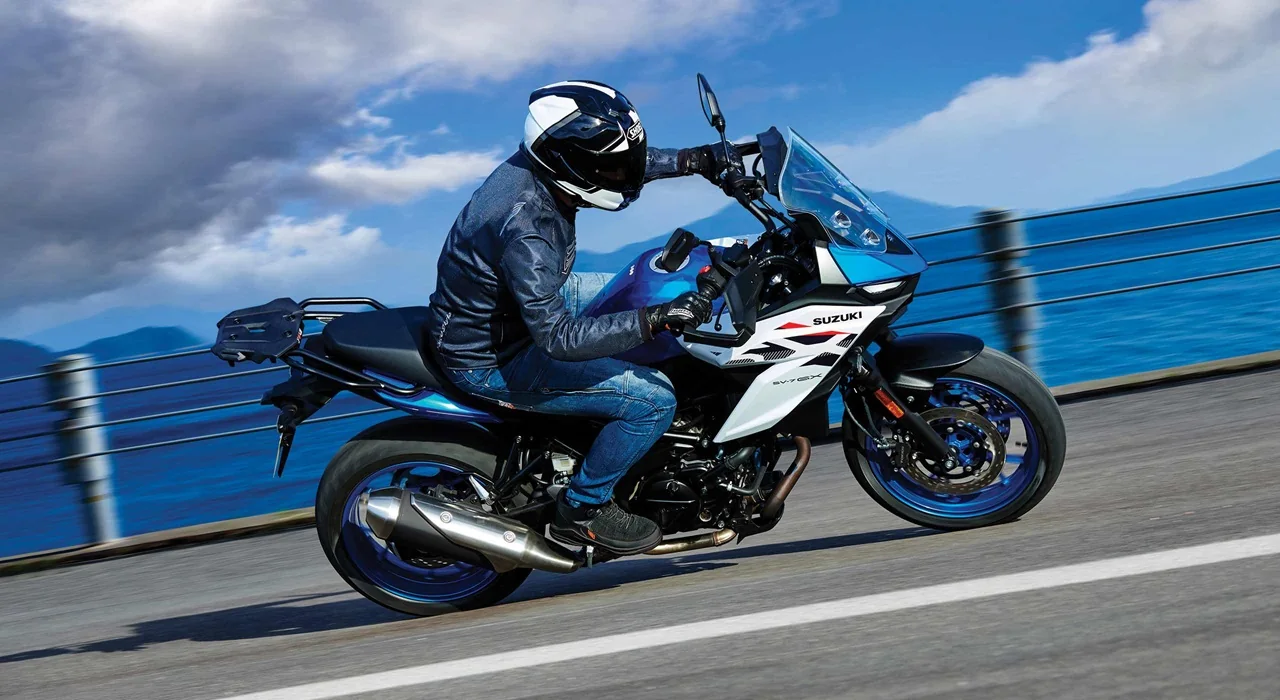
The tubular steel trellis frame is the SV650’s, with a 1,445 mm wheelbase, 25 degrees of rake and 106 mm of trail. Handling is where both testers were most enthusiastic. Oliver rode it over Palomar Mountain’s hairpins and wrote that tipping in “took light effort” and that the bike held its line under braking, steady throttle or acceleration. De Sena said the same in fewer words: turn-in takes little effort and it holds a line without drama.
Part of that is the tyres. Suzuki has fitted Pirelli Angel GT II sport-touring rubber in 120/70ZR17 and 160/60ZR17. The 160 rear is narrower than the 180 on bigger bikes, which is why it steers so easily, and both sizes are common and affordable in South Africa.
The suspension is where the price shows. The 41 mm conventional fork is a damping-rod design with no adjustment and 125 mm of travel. The rear is a link-type shock with 129 mm of travel and seven steps of preload. Ridden smoothly it works. Ridden hard, both tests reported fork dive under braking and a rear that gets bouncy over repeated bumps. De Sena’s summary was that the bike rewards a rider who flows rather than one who bullies it. On South African roads, where a patched B-road is the norm, that matters, and heavier riders or regular two-up tourers should budget for a fork kit and a better shock down the line.
Brakes are similarly basic: twin 290 mm floating discs with axial-mount Tokico four-piston calipers at the front, a 240 mm disc with a Nissin single-piston caliper at the rear, and conventional two-channel ABS with no cornering function. Oliver found them “perfectly fine” for the road. De Sena described the bite as gentle and progressive and the ABS as a little eager to step in.
Seat height, comfort and touring kit

The 795 mm seat is one of the bike’s strongest cards. That is 40 mm lower than a V-Strom 250SX and about the same as a BMW F 450 R, on a bike with real touring ability. A V-twin is narrow between the knees, the seat is narrow at the front, and a 1.78 m tester with an 81 cm inseam got both feet flat with ease. Riders from about 1.62 m should manage.
The riding position is upright and neutral. The seat is the one consistent complaint. Despite the extra padding, both RevZilla riders found it less comfortable than they wanted after a couple of hours, and sliding back to the wider part left their arms at full stretch. TopSpeed agreed that soreness creeps in after a few hours. Suzuki sells a thicker accessory seat, and that tells its own story.
The windscreen moves through three positions over about 50 mm. In the standard position the airflow hit a 1.78 m rider at the top of the forehead. One genuinely silly detail: adjusting it needs a hex key, and neither of the two keys in the under-seat toolkit fits. Pack your own.
For luggage, the rear carrier is standard and takes Suzuki’s 27 or 45 litre top boxes or any aftermarket plate. Soft throw-over panniers and a tank bag are in the accessory catalogue; there are no factory hard panniers. The TFT pairs with the new Suzuki Ride Connect+ app for calls, alerts and turn-by-turn navigation, though RevZilla could not get the app to install during the test, so treat that as unproven.
Will it come to South Africa, and at what price?
Nothing is confirmed. What can be said is that the SV-7GX makes sense here. Suzuki South Africa’s current range jumps from the V-Strom 250SX at R63,400 to the V-Strom 650XT at R166,650 and the GSX-8S at R179,950, with no SV650 in between. The updated V-twin was built to be sold worldwide, and the 650XT it would sit alongside uses the engine it replaces.
On price, the overseas numbers are the guide. In the United States the SV-7GX is $8,599, well under the $10,399 Kawasaki Versys 650 LT. In the United Kingdom it starts at £6,999. In both markets it is positioned as the affordable option, below the V-Strom. A South African price somewhere between R140,000 and R160,000 would keep that relationship with the R166,650 V-Strom 650XT. That is our estimate, not Suzuki’s, and we will update this article if a local price is announced.
Overseas there are four colours: Pearl Brilliant White with Metallic Triton Blue and blue wheels, Pearl Matte Greige with red wheels, Glass Sparkle Black, and a plain Pearl Brilliant White with black wheels that America sells as the SV-7GXV for $200 less. The graphics are decals rather than paint.
What it would cost to run in South Africa
Petrol is the big variable this month. The October 2026 adjustment, effective 7 October, is projected to take inland 95 unleaded to about R30 a litre, with 93 a little below that. The SV-7GX runs on 93, but the sums below use R30 to be safe.
Suzuki claims the equivalent of 4.2 litres per 100 km, and TopSpeed’s test matched it. Call it 4.5 if you use the midrange the way the engine invites you to.
- A full 17.4 litre tank costs about R520.
- Range on that tank is roughly 385 to 410 km, enough for Johannesburg to Harrismith and most of the way back.
- Fuel cost per kilometre is about R1.30.
- A 40 km round-trip commute costs about R52 a day.
- Over 22 working days that is roughly R1,150 a month in petrol.
A small hatchback at 7.5 litres per 100 km costs about R2.25 per kilometre at the same price, so the Suzuki saves around 40 percent on fuel while being quick enough to tour on.
The engine is the other half of the running cost story. This V-twin has been in production since 1999, every Suzuki workshop in the country knows it, and parts are shared with the SV650 and V-Strom 650 that have been sold here for years. The self-synchronising throttle bodies remove one service item. A 160-section rear tyre is cheaper than a 180 and should last 10,000 km or more in sport-touring compound. Budget for a chain and sprockets around 25,000 km, and ask the dealer for the valve clearance interval and price before you sign, because that is the big service on any V-twin.
Licence requirements in South Africa
South Africa has two motorcycle licence codes. Code A1 covers bikes up to 125cc from age 16. Code A covers everything else from age 18. At 645cc the SV-7GX needs a full Code A. A Code A1 or a car licence does not cover it, and riding on the wrong code voids your insurance.
There is no power-limited step between the two codes here, so nothing in law stops a newly licensed rider buying a 54 kW bike. The SV650 has always been one of the gentler ways to do that, and the SV-7GX adds a 45 kW Comfort mode and traction control on top. Our guide to what a motorcycle licence costs in South Africa covers the fees and the tests.
SV-7GX versus the alternatives
Suzuki V-Strom 650XT
The bike you can actually buy today, at R166,650. Same engine family, 19 inch front wheel, spoked rims, more suspension travel, a taller seat and a bigger tank. If your touring includes gravel, the V-Strom is still the right Suzuki. If it does not, the SV-7GX is lighter, lower, sharper on tar, has the newer electronics and a quickshifter, and should cost less.
Kawasaki Versys 650
The direct rival everywhere it is sold. The Versys has a parallel-twin of similar output, an adjustable upside-down fork, a bigger screen and factory panniers on the LT version. It is also taller, bulkier and $1,800 more in America. The Suzuki answers with the V-twin, the quickshifter and the lower seat. Confirm current Versys pricing with a Kawasaki dealer, as it has moved.
Triumph Tiger Sport 660
More powerful, with a 660cc triple, cruise control and better suspension, and priced about $1,850 above the Suzuki in the United States. It is the better tourer and the better motorcycle on paper. Whether it is worth the gap depends on how often you ride more than two hours at a time.
Honda NX500 and Transalp 750
The two Hondas bracket the Suzuki. The Honda NX500 is listed new on Scooter125 at R109,899: a 471cc twin with 35 kW, lighter and cheaper but noticeably slower two-up. The Honda Transalp 750 is listed new at R229,999: 67 kW, a 21 inch front wheel and real off-road ability at a much higher price. The SV-7GX would land between them, and for a rider who never leaves tar it covers most of what either does.
A used sport-tourer
At the money the SV-7GX is likely to cost, the used market offers bigger bikes. Dealers on Scooter125 list used BMW adventure bikes in that price range, for example, some with far more power and electronics than the Suzuki. You give up the warranty and take on bigger service bills. Browse the used bikes for sale and adventure bikes for sale to see what the same budget buys.
Full specifications
| Specification | Detail |
|---|---|
| Engine | 645cc, 90 degree V-twin, DOHC, 4 valves per cylinder, liquid cooled |
| Bore and stroke | 81.0 mm by 62.6 mm |
| Compression ratio | 11.2 to 1 |
| Power | 54 kW (72.4 hp) at 8,500 rpm |
| Torque | 64 Nm at 6,800 rpm |
| Fuel system | Fuel injection, ride-by-wire, twin 39 mm electronic throttle bodies |
| Transmission | 6 speed, assist clutch, bi-directional quickshifter |
| Final drive | O-ring chain, 15/46 sprockets |
| Frame | Tubular steel trellis |
| Front suspension | 41 mm telescopic fork, 125 mm travel, non-adjustable |
| Rear suspension | Link-type single shock, 129 mm travel, 7-step preload |
| Front brakes | Twin 290 mm floating discs, Tokico 4-piston calipers, ABS |
| Rear brake | 240 mm disc, Nissin single-piston caliper, ABS |
| Tyres | 120/70ZR17 front, 160/60ZR17 rear, tubeless, Pirelli Angel GT II |
| Rider aids | Three drive modes (A, B, C), traction control with 3 levels plus off, Easy Start, Low RPM Assist |
| Instruments | 4.2 inch colour TFT, Suzuki Ride Connect+ app, USB-C port (5 V, 3 A) |
| Lighting | Full LED, projector headlight |
| Length, width, height | 2,160 mm, 910 mm, 1,295 mm |
| Wheelbase | 1,445 mm |
| Rake and trail | 25 degrees, 106 mm |
| Ground clearance | 135 mm |
| Seat height | 795 mm |
| Kerb mass | 211 kg |
| Fuel capacity | 17.4 litres |
| Claimed consumption | About 4.2 litres per 100 km (56 mpg US) |
| Standard equipment | 3-position windscreen, knuckle covers, rear carrier with grab rails, 740 mm tapered aluminium handlebar |
| Overseas price | $8,599 (United States), from £6,999 (United Kingdom) |
| South African price | Not announced |
Frequently asked questions
Is the Suzuki SV-7GX available in South Africa?
Not yet. It is on sale in the United States and the United Kingdom, but Suzuki South Africa does not list it and has made no announcement. Ask your Suzuki dealer to register your interest, because dealer demand is what gets a model onto the local price list.
How much would the SV-7GX cost in South Africa?
There is no official price. Overseas it sits below the V-Strom 650, which is R166,650 here, so we estimate R140,000 to R160,000 if it is brought in. Treat that as a guide only.
Is the SV-7GX a 700?
No. The engine is the same 645cc V-twin as the SV650. The “7” is a naming convention that lines it up with the bigger GSX-S1000GX.
Is the SV-7GX a good first big bike?
Yes, for the same reasons the SV650 always was: a low 795 mm seat, a smooth and forgiving engine, light steering and a modest 211 kg. It adds traction control and a Comfort mode that limits power to about 45 kW while you find your feet.
Does the SV-7GX have cruise control?
No, even though it has a ride-by-wire throttle. Both first ride reviews named that as the feature they missed most. It does have a two-way quickshifter as standard.
Can the SV-7GX go off-road?
It is a road bike. With 17 inch wheels, road tyres and 135 mm of ground clearance, a smooth gravel driveway is fine and a corrugated district road is not what it was built for. For gravel, look at the V-Strom 650XT or the V-Strom 250SX.
What fuel does it use and how far will it go?
It runs on regular unleaded, so 93 is fine. At about 4.2 litres per 100 km the 17.4 litre tank gives roughly 400 km.
The verdict
The SV-7GX is not the most powerful middleweight sport-tourer, nor the best suspended, nor the best equipped. What it has is the thing the SV650 always had: an engine with real character in a chassis that makes ordinary riders feel good, at a price below the competition. The fairing, screen, rack, bigger tank and electronics turn that into a bike you can commute on all week and take to the coast at the weekend.
The weak points are known and fixable: a seat that runs out of comfort after two hours, soft budget suspension and no cruise control. None of them is a reason to walk away at the price it sells for overseas.
For South Africa the only real question is whether Suzuki brings it in. If it does, at anything under the V-Strom 650XT’s price, it becomes the obvious step up from a 250 or 300 for anyone who rides on tar. Until then, get the Code A sorted, tell your dealer you want one, and see what the adventure and touring bikes for sale on Scooter125 are going for.
Sources referenced
- Suzuki Motor Corporation, global SV-7GX model page and specifications
- Suzuki Motor USA, 2027 SV-7GX model page, pricing and features
- RevZilla Common Tread, Lance Oliver, “2027 Suzuki SV-7GX first ride review: ¡Viva la V!”, 25 September 2026
- TopSpeed, Nic de Sena, “2027 Suzuki SV-7GX Review: The SV650, Gone Sport-Touring”, 2 October 2026
- Suzuki South Africa, motorcycle range and pricing as at 3 October 2026
- Honda NX500, Honda Transalp 750 and BMW listings on Scooter125, October 2026
- Central Energy Fund projections for the October 2026 fuel price adjustment