Kawasaki W230 (2026) Review: The 143 kg Retro Single, Specs and What It Would Cost in South Africa
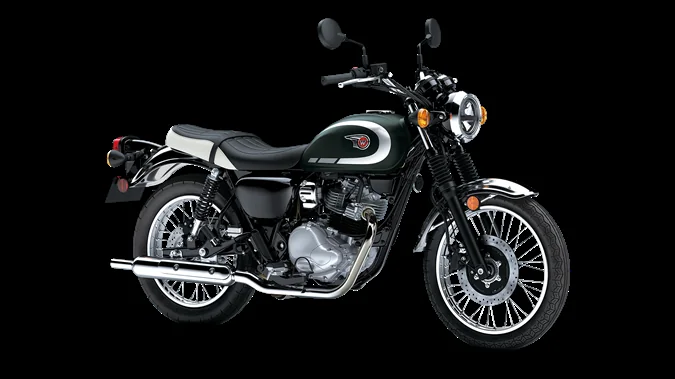
The Kawasaki W230 is a 233cc air-cooled single dressed as a 1965 motorcycle: chrome mudguards, a teardrop tank with a three-dimensional W badge, wire wheels, fork gaiters, a peashooter silencer and two round clocks. It weighs 143 kg with fuel, its seat is 745 mm from the ground, and it makes 13 kW. Motorcycle News rode it in October 2026, gave it four stars, called it an old-school charmer, and then said it costs too much.
Kawasaki South Africa does not list the W230, and neither does it list the W800 it descends from. The small retro class here belongs to Royal Enfield and Triumph. This review covers what the bike is, how it rides, what the British test and American owners found, what it would cost to buy and run here if Kawasaki brought it in, and whether a Hunter 350 or a Speed 400 is the better buy.
This is a research based review. Scooter125 has not ridden the W230 and the bike was not supplied by Kawasaki or a dealer. Specifications come from Kawasaki UK, Kawasaki USA, Kawasaki Europe and MotorcycleSpecs.co.za. Riding impressions come from Motorcycle News’ October 2026 test, with background from Carole Nash and owner discussion on the ADVrider forum. South African pricing is our estimate and is labelled as such. The running cost sums are our own, at the October 2026 fuel price.
What you need to know first
The W230 is Kawasaki’s smallest retro: a 233cc, air-cooled, two-valve single with fuel injection and a balancer shaft, making 12.9 kW (18 PS) at 7,000 rpm and 18.6 Nm at 5,800 rpm, in a steel semi-double-cradle frame with a 37 mm fork, twin shocks, an 18 inch front and 17 inch rear wire wheel, a 265 mm front disc and ABS. It weighs 143 kg with its 12 litre tank full, the seat is 745 mm, and Kawasaki claims 2.5 litres per 100 km. The engine is a retuned version of the one in the KLX230 trail bike, and the speedometer stops at an indicated 115 km/h.
It costs £4,654 in Britain, $5,699 plus delivery in the United States and ¥665,500 in Japan. Kawasaki South Africa has not listed it. At current exchange rates the British price is about R102,000, and our estimate is R95,000 to R105,000 if it arrives. Royal Enfield South Africa sells the Hunter 350 for R80,900 and the Classic 350 for R93,500; the Triumph Speed 400 is about R105,000.
Motorcycle News rated it four out of five: charming, stylish, light, nimble and pleasingly spirited, with a four-year warranty in Britain. Its reservations were the price against a Honda GB350S, the lack of speed above 80 km/h, and finish details that do not match the money: plastic side panels, black mirrors, a thin seat and no fuel gauge. It is built in Thailand.
What the W230 is


Kawasaki’s W line began with the 1965 650-W1, the company’s first four-stroke and Japan’s biggest motorcycle at the time, itself derived from the Meguro K1 and, before that, the BSA A7. The W1 sold until 1974, the W650 revived the name in 1999, and the W800 has carried it since 2011. Through the same years Kawasaki sold the Estrella, a 250cc single with the same silhouette, in Japan from 1992 to 2017. The W230 is the Estrella’s successor in all but name, launched in Japan for 2025 with a chrome-tanked sibling called the Meguro S1, and brought to Europe and America for 2026 after what Kawasaki Europe called a successful debut year.
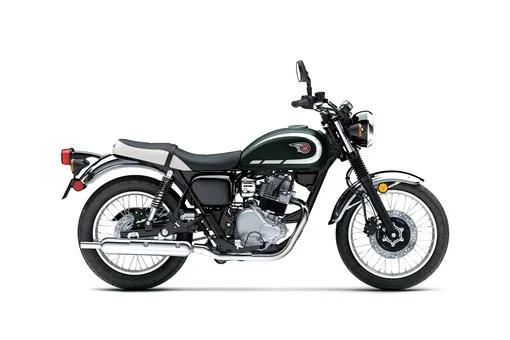
The styling is faithful: steel mudguards, a slim teardrop tank with the 3D W emblem, a flat one-piece seat with a white-piped edge, a peashooter exhaust, rubber fork gaiters, a round LED headlight in a chrome shell and twin analogue dials with a small LCD insert. Carole Nash said it captures the spirit of 1960s lightweights like the Triumph Tiger Cub, and that is the right comparison: this is a small bike that looks like a small bike, not a 350 pretending to be bigger.
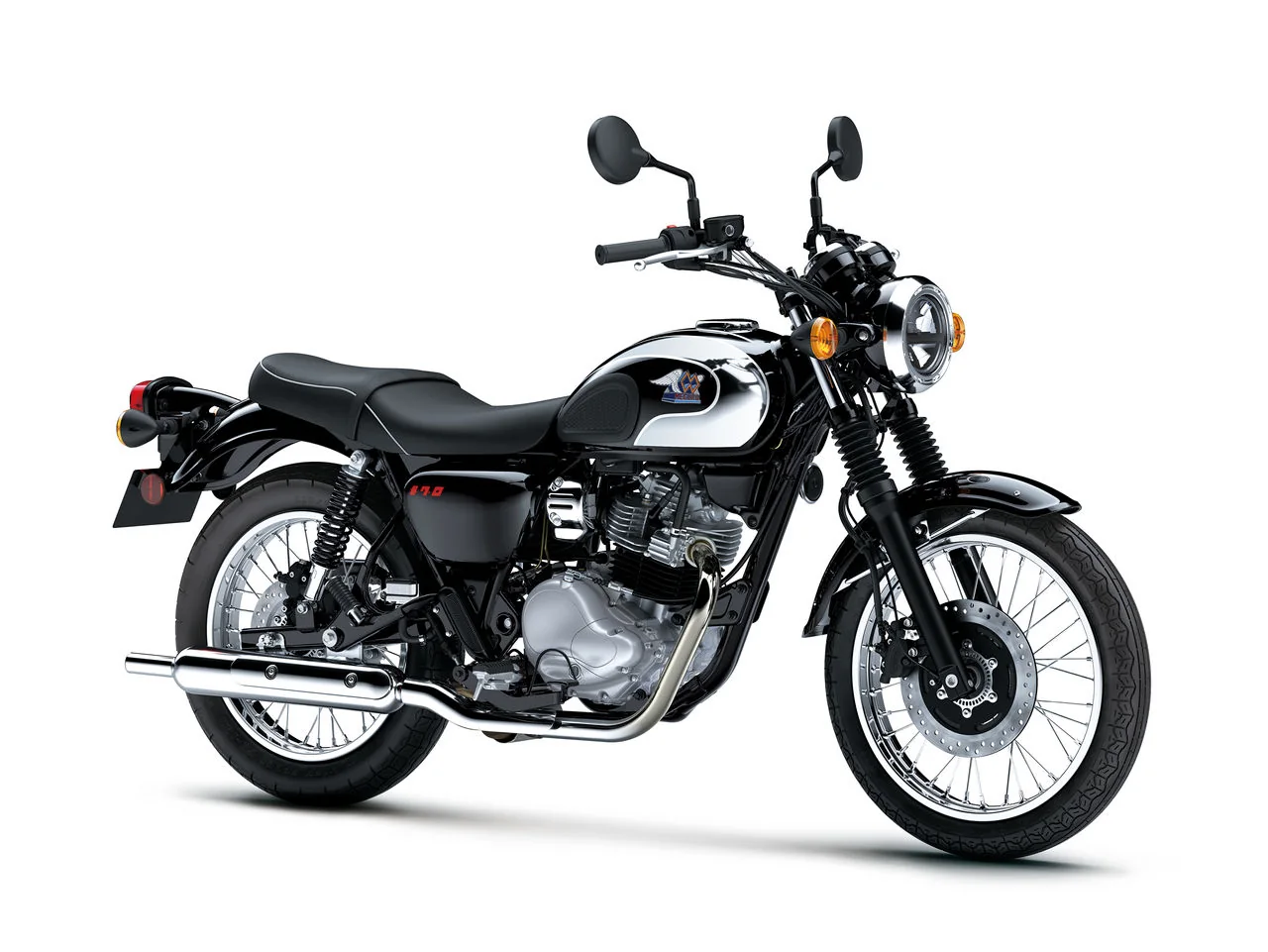
For 2026 the colour is Metallic Matte Dark Green with ebony panels, replacing the 2025 blue, and Kawasaki UK offers only that one. The American range adds Candy Persimmon Red, and an Ebony version with a chrome tank panel is due for 2027. The Meguro S1 is the same bike with a chromed tank, painted panels, different meters and seat finish, and the old Meguro marque’s badges.
The 233cc single
The engine is the KLX230 trail bike’s air-cooled SOHC two-valve single, 67 mm by 66 mm, 9.0:1 compression, with a 32 mm throttle body and a balancer shaft, retuned for a road bike with more low and mid-range pull and a fine-tuned exhaust note. Kawasaki UK quotes 12.9 kW at 7,000 rpm and 18.6 Nm at 5,800 rpm; the American figure is 17 hp on the ISO standard, which is the same engine measured differently. The gearbox is a six-speed with Kawasaki’s positive neutral finder, and the clutch is a plain wet multi-plate with a light pull.
Motorcycle News managed expectations in one sentence: the single is happy enough to zip up to 60 mph, which is about 100 km/h, and that is about as far as it goes, with a limiter at an indicated 72 mph or 115 km/h. In the flow of traffic the lack of pace does not matter. Overtaking a car at 80 km/h needs pre-planning and a long straight. The engine is rev-happy and spends most of its time above 5,000 rpm, where MCN still averaged 70 mpg, which is 4.0 litres per 100 km. Kawasaki’s claim is 2.5.
The point MCN made is that the W230 only works because it is light. The same engine in a heavier bike, or with longer gearing, would feel gutless; at 143 kg the performance is on a level with the 350cc rivals that weigh 40 kg more. At Highveld altitude a naturally aspirated engine loses roughly 15 percent, so in Gauteng this is an 11 kW motorcycle, and the limit becomes the N1 rather than the limiter. Around town and on the back roads it was built for, that is enough.
Chassis, suspension and brakes
The frame is a tubular steel semi-double cradle with a 27 degree rake, 99 mm of trail and a 1,415 mm wheelbase, which is short. The fork is a 37 mm conventional unit with 117 mm of travel and no adjustment; the twin rear shocks have 95 mm of travel and five-step preload. Ground clearance is 150 mm. The wheels are wire-spoked, 18 inches at the front and 17 at the rear, on IRC Grand High Speed tyres in old-fashioned sizes, 90/90-18 and 110/90-17.
Brakes are a single 265 mm front disc with a two-piston sliding caliper and a 220 mm rear disc, both with ABS as standard. Nobody will call them strong, but on a 143 kg bike with 18 PS they do not need to be, and MCN had no complaint. The tyres surprised it: the IRCs and the skinny wheels deliver a more assured ride than you would expect, and the damping is supportive over everything except harsh bumps. For the price, it said, there is little to moan about.
One practical note from the American owners’ forum: the 110/90-17 rear tyre is an uncommon size, and one buyer who had put money down on a 2026 bike called it about as common as hen’s teeth. In South Africa that means asking the dealer who stocks it before you need one.
How it rides


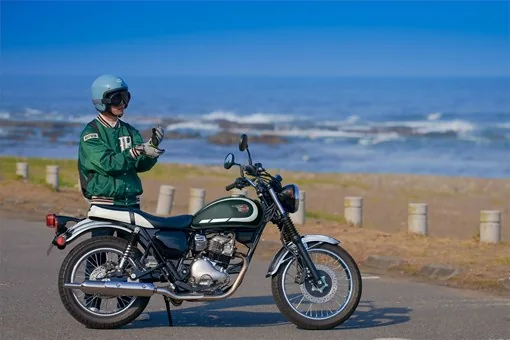
Motorcycle News’ description of the W230 on the road is the reason to consider it. At 143 kg it is more than 40 kg lighter than any rival and physically smaller, which makes it extremely light and nimble, effortless to manoeuvre at low speed and impressively agile once rolling. The engine is peppy and the whole thing is pleasingly spirited. MCN called it charming and stylish, and gave it four stars with the price as the main deduction.
The limits are the ones the numbers predict. It cruises at 100 km/h, will show 115 and no more, and asks for planning on overtakes. Longer-legged riders will find the pegs oddly high. The seat is thin. Above about 90 km/h the upright riding position and no screen mean you are the aerodynamics, and MCN said overtakes above 50 mph are unrealistic in some situations for exactly that reason.
The honest framing comes from the ADVrider thread, where the buyers are retired riders with big bikes in the garage who want something small, light and reliable for empty country roads and have stopped caring about top speed. One is trading a Yamaha SR400 for it because the Kawasaki is 30 kg lighter. Another plans to use it to take grandchildren on country rides. That is the W230’s rider, and for that rider it is close to ideal.
Equipment, finish and the price question
Standard equipment is what the period demands and no more: LED headlight and tail light, twin analogue clocks with an LCD insert for the odometer, trip and clock, ABS, fuel injection and a sealed chain. There is no fuel gauge, no gear indicator, no riding modes and no USB socket; Kawasaki sells a USB-C kit as an accessory that MCN called ugly and out of keeping, along with a chrome rear carrier, rubber tank knee pads and chrome engine guards.
MCN’s sharpest criticism was the finish. Kawasaki points to the chrome mudguards and bars, spoked wheels, stylish exhaust and period clocks, but the mirrors are black plastic rather than chrome, the side panels are plastic rather than metal, the seat padding is thin and there is no fuel gauge. Its conclusion was that the bike does not feel worth £4,654 when a Japanese-built Honda GB350S costs £3,999, a Royal Enfield Classic 350 costs £4,549 and a BSA Bantam 350 costs £3,499, all with bigger engines, and when the W230 itself is built in Thailand. The price, it said, needs to match the Honda’s.
The counterweights are a four-year warranty in Britain, Kawasaki’s dealer network, and the fact that none of those rivals is 143 kg. In South Africa the argument changes shape, because the Honda is not sold here and the Royal Enfields are cheaper than they are in Britain.
Seat height and comfort
The seat is 745 mm, among the lowest of any motorcycle on sale, and the bike is slim, so almost anyone can put both feet flat. The riding position is upright with a wide flat bar and pegs set a little high and forward, which suits shorter riders and bothers tall ones. MCN found the seat lacking padding over a day; the one-piece bench is long enough for a pillion but the W230 is not a two-up tourer.
Vibration is controlled by the balancer shaft and the single is smooth for its type at commuting speeds. The 12 litre tank at MCN’s real-world consumption gives about 290 km, which Kawasaki rounds up to 180 miles; at the claimed figure it would be well over 400. There is no fuel gauge, so the trip meter is your gauge.
What owners say
The W230 arrived in Britain in January 2026 in a small batch, and Motorcycle News had no owner reviews when it published. The American owners on ADVrider, where the bike has been on sale since 2025, give a consistent picture: it is expensive for what you get, it is limited to about 70 mph like the KLX230 it shares an engine with, dealers add so much to the price that one buyer was quoted about $8,000 out the door in California against a $5,699 list, and a Royal Enfield Hunter 350 costs half as much. And they are buying it anyway, because nothing else that looks like this weighs 143 kg.
The 2026 matte green is preferred over the 2025 blue. The rear tyre size worries people. Nobody reports a mechanical problem, which is what you would expect of a KLX230 engine that has been in production for years.
Price and availability in South Africa
Kawasaki South Africa’s website lists the Ninja 500 and its off-road range, but not the W230, the Meguro S1 or the W800. Kawasaki Europe’s own announcement says colour and model availability is confirmed market by market, so the first step is to ask a Kawasaki dealer whether it is coming. Nothing has been announced.
For an estimate, the British price of £4,654 is about R102,000 at current exchange rates, and Kawasaki South Africa’s Ninja 500 price sits almost exactly on its British price converted the same way. The W230 is built in Thailand, which usually helps a South African landed price. Our estimate is R95,000 to R105,000 if Kawasaki lists it, with the aggregator sites that guess at local prices well below that and not to be relied on. We will update this page when a rand price appears.
What it would cost to run
Petrol is at a record. The October 2026 adjustment took inland 95 unleaded to about R30 a litre. With 9.0:1 compression the W230 runs happily on 93, which saves a little at every fill.
Kawasaki claims 2.5 litres per 100 km on the WMTC cycle, which is a 233cc single ridden gently. Motorcycle News averaged 4.0 at the revs it needs to keep up with traffic. We have used 3.5.
- A full 12 litre tank costs about R360.
- Range is roughly 340 km, and there is no fuel gauge, so set the trip.
- Fuel costs about R1.05 a kilometre, the lowest of any bike we have reviewed.
- A 40 km round-trip commute costs about R42 a day, or roughly R920 over 22 working days.
The engine is a simple air-cooled two-valve single with a long service record in the KLX230, and valve checks are a home-mechanic job. Tyres are cheap but in odd sizes, so find a supplier before you need one. Insurance on a R100,000 commuter will be modest, and a four-year warranty, if Kawasaki South Africa matches Britain’s, would cover most of a first owner’s time with it.
Licence requirements in South Africa
South Africa has two motorcycle licence codes. Code A1 covers bikes up to 125cc from age 16. Code A covers everything else from age 18. At 233cc the W230 needs a full Code A, and a car licence does not cover it.
As a first motorcycle it is close to perfect: 143 kg, a 745 mm seat, 18 PS, ABS, fuel injection and nothing to configure. It is the kind of bike a learner can take a test on and then keep. Our guide to what a motorbike licence costs in South Africa covers the fees and the tests.
W230 versus the alternatives
South African prices are the importers’ list prices at the time of writing and change often. The Kawasaki figure is our estimate.
Royal Enfield Hunter 350
R80,900 from Royal Enfield South Africa. The 349cc J-series single makes about 15 kW, the bike weighs about 180 kg and the seat is 790 mm. It is the obvious rival here: more engine, more weight, a lower price and a dealer network that already exists. ADVrider owners who have ridden both call the Hunter nice but big and heavy by comparison.
Royal Enfield Classic 350
R93,500 from Royal Enfield South Africa. The same engine in the full retro costume, at about 195 kg. It is the bike the W230 most resembles in intent and the one it is lightest against; on our estimate the Kawasaki would cost a little more for a lot less bike and 50 kg less weight.
Triumph Speed 400
About R105,000. A 398cc liquid-cooled single with about 29 kW, 176 kg and a modern chassis in retro clothes. It is a class faster than the W230 and the same money on our estimate, which is the comparison that will decide most buyers. The Kawasaki’s answer is weight, simplicity and the look.
Honda GB350S and BSA Bantam 350
The two bikes Motorcycle News used to call the W230 overpriced in Britain. Neither is sold in South Africa.
Nothing on the South African market combines this weight with this styling. Start with the naked and retro bikes for sale on Scooter125 to see what R100,000 buys among the bikes that are here.
Full specifications
Figures from Kawasaki UK, Kawasaki USA and MotorcycleSpecs.co.za for the 2026 W230. Where they differ, both are given.
| Engine | 233cc air-cooled SOHC 2-valve single with balancer shaft |
| Bore x stroke | 67 x 66 mm |
| Compression ratio | 9.0:1 |
| Power | 12.9 kW (18 PS) at 7,000 rpm; 17 hp ISO in the United States |
| Torque | 18.6 Nm at 5,800 rpm |
| Fuel system | Fuel injection, 32 mm throttle body |
| Gearbox | 6-speed with positive neutral finder, wet multi-plate clutch, sealed chain |
| Frame | Tubular steel semi-double cradle |
| Front suspension | 37 mm telescopic fork, 117 mm travel |
| Rear suspension | Twin shocks, 5-step preload, 95 mm travel |
| Front brake | 265 mm disc, 2-piston caliper, ABS |
| Rear brake | 220 mm disc, single-piston caliper, ABS |
| Wheels and tyres | Wire-spoked 18 inch front and 17 inch rear; IRC 90/90-18 and 110/90-17 |
| Rake and trail | 27 degrees, 99 mm (94 mm on the US sheet) |
| Wheelbase | 1,415 mm |
| Length x width x height | 2,125 x 800 x 1,090 mm |
| Seat height | 745 mm |
| Ground clearance | 150 mm |
| Kerb weight | 143 kg (133 kg dry) |
| Fuel tank | 12 litres (11.7 on the US sheet) |
| Claimed consumption | 2.5 litres per 100 km; MCN saw 4.0 |
| Top speed | Limited to an indicated 115 km/h |
| Instruments | Twin analogue dials with LCD odometer, trip and clock; no fuel gauge |
| Lighting | LED headlight and tail light |
| Colours | Metallic Matte Dark Green (2026); Candy Persimmon Red in the US; Ebony for 2027 |
| UK price | £4,654 |
| US price | $5,699 plus $435 delivery |
| South African price | Not listed by Kawasaki South Africa; our estimate R95,000 to R105,000 |
Frequently asked questions
How much is the Kawasaki W230 in South Africa?
Kawasaki South Africa has not listed it. It costs £4,654 in Britain and $5,699 in the United States, which points to roughly R95,000 to R105,000 here. That is our estimate; ask a Kawasaki dealer whether it is coming.
How fast is the Kawasaki W230?
It cruises at about 100 km/h and is limited to an indicated 115 km/h. Motorcycle News found overtaking above 80 km/h needs planning.
What engine is in the W230?
A 233cc air-cooled, fuel-injected, two-valve single from the KLX230 trail bike, retuned for the road, with a balancer shaft. It makes 12.9 kW (18 PS) and 18.6 Nm.
What is the seat height of the W230?
745 mm, one of the lowest of any motorcycle on sale, on a bike that weighs 143 kg with fuel.
Is the W230 a good first bike?
Yes. It is light, low, simple, has ABS and fuel injection, and the power is gentle. It needs a Code A licence because it is over 125cc.
Where is the W230 built?
Thailand, like the KLX230 it shares an engine with. Motorcycle News made that part of its argument that the British price is too high.
What is the difference between the W230 and the Meguro S1?
The same bike. The S1 has a chromed tank with painted panels, Meguro badges, different meters and seat trim, and comes in Ebony.
What is the fuel consumption of the W230?
Kawasaki claims 2.5 litres per 100 km. Motorcycle News averaged 4.0 at the revs needed to keep up with traffic, which still gives about 300 km from the 12 litre tank.
The verdict
The W230 is a lovely small motorcycle. It has the W1’s shape, the Estrella’s size and an engine that will run forever, and at 143 kg it is the lightest thing in its class by the weight of a passenger. Motorcycle News was right that it is charming, spirited and easy, and right that it is slow above 100 km/h and finished to a budget in places that the price does not admit.
In South Africa the case is simpler than in Britain, because the Honda that undercuts it is not here. The real comparison is a Royal Enfield Hunter 350 at R80,900 and a Triumph Speed 400 at about R105,000. The Enfield is cheaper and the Triumph is faster, and both have dealers today. The Kawasaki would need to land near R95,000, with the four-year warranty, to make sense against them.
If Kawasaki South Africa brings it in at that money, it is the first bike we would recommend to a new rider who wants something with a soul. Until then, the naked and retro bikes for sale on Scooter125 are where to look, and we will update this review the day a rand price appears.
Sources referenced
- Kawasaki UK, W230 2026 model page: price, colour and full specification
- Kawasaki USA, 2026 W230 ABS model page: price, delivery charge and accessories
- Kawasaki Europe, “W230 and Meguro S1 to feature in 2026 Kawasaki range”, 22 July 2025
- MotorcycleSpecs.co.za, “2026 Kawasaki W230”: specification table
- Motorcycle News, Jon Urry, “2026-on Kawasaki W230 review”, 6 October 2026
- Carole Nash, “Nice surprise as Kawasaki introduce W230 for 2026”, November 2025
- ADVrider forum, “The Kawasaki W230 thread”, October 2025 to January 2026
- Total Motorcycle, 2026 Kawasaki W230 ABS specifications
- Royal Enfield South Africa, Hunter 350 and Classic 350 model pages; Triumph Speed 400 South African dealer pricing
- Department of Mineral and Petroleum Resources, October 2026 fuel price adjustment