Honda X-ADV Review: The DCT Adventure Scooter, 2025 Update, Specs and What It Would Cost in South Africa

Honda has sold more than 76,000 X-ADVs in Europe since 2017, and in 2023 it was the company’s second best-selling motorcycle there. South African riders mostly look at it and ask what it is. The honest answer is that it is an NC750X with the clutch lever removed, the footrests replaced by running boards, a helmet-sized boot under the seat and adventure-bike wheels, suspension and styling. Italians, French and Spanish riders buy it as an everyday GS. The British press has spent eight years telling its readers they should too.
The 2025 update, which carries into the 2026 and 2027 model years, smoothed the dual-clutch gearbox at walking pace, added cruise control, a new dash, a sharper face and a one-handed screen. Honda South Africa does not list the X-ADV on its current showroom page, so this review also deals with what it would cost here if a dealer orders one, and what the money buys instead.
This is a research based review. Scooter125 has not ridden the X-ADV and the bike was not supplied by Honda or a dealer. Specifications come from Honda UK and MotorcycleSpecs.co.za. Riding impressions come from Motorcycle News, Bennetts BikeSocial, Visordown and 1000PS, who tested the updated bike, from Visordown’s long-term test, a Belgian road test on Team Throttle, a Swiss test ride reported on Team-BHP, and owner reviews on Motorcycle News. South African pricing is our estimate and is labelled as such. The running cost sums are our own, at the October 2026 fuel price.
What you need to know first
The Honda X-ADV is a 745cc parallel-twin crossover between a maxi-scooter and an adventure bike. It makes 43.1 kW (58 hp) at 6,750 rpm and 69 Nm at 4,750 rpm, drives through Honda’s six-speed dual-clutch transmission with no clutch lever, weighs 237 kg with fuel, has an 820 mm seat, a 13.2 litre tank, 22 litres of storage under the seat and a claimed top speed of 168 km/h. Wire-spoked 17 and 15 inch wheels, 150 mm of suspension travel at each end and a Gravel riding mode are what separate it from the Forza 750 scooter it shares its engine and frame with.
The 2025 update left the engine and chassis alone and improved the things owners touch: a DCT that no longer stutters at walking pace, cruise control as standard, a 5 inch TFT dash with phone navigation, a thicker seat, a screen you can adjust with one hand, LED projector headlights with the indicators built into the daytime running lights, and bodywork made partly from plant-based and recycled plastic. The UK price is £11,499, or £12,799 for the Special Edition with the comfort and adventure packs fitted.
Motorcycle News gave it four stars and its owners rate it 4.5. Bennetts called the DCT the standard other semi-automatics are measured against. The criticisms are the ones you would expect: it is heavy, wide and tall at the step-through, the engine is gentle rather than quick, the NC750X and Transalp are cheaper, and you will spend a lot of time explaining what it is.
What the X-ADV is
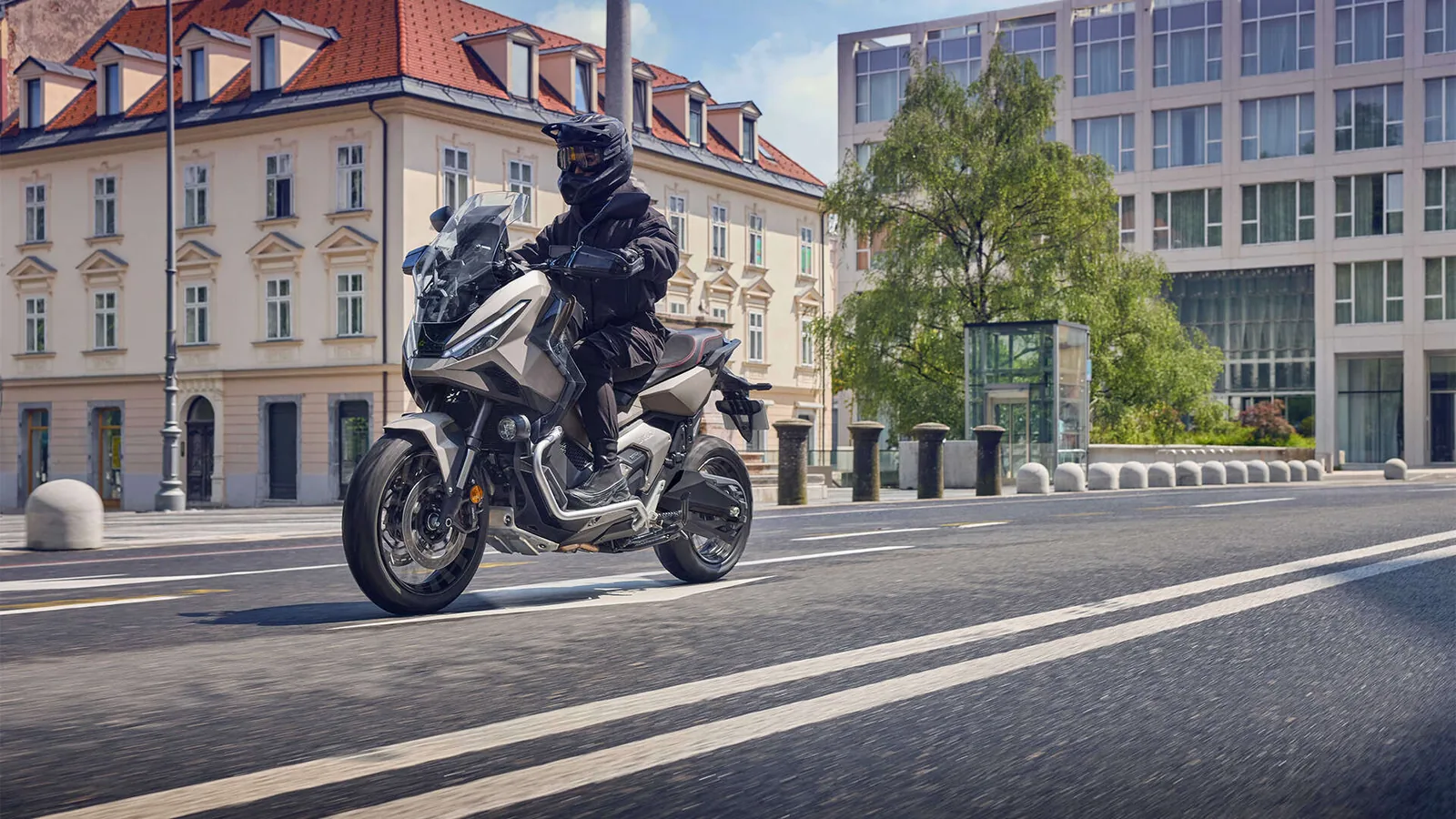
Honda’s Italian design studio drew the X-ADV around the NC750 platform in 2016. The engine sits canted forward and low in a tubular steel frame, which leaves room for a flat floor and a step-through, and the chain final drive is enclosed so it looks like a scooter’s belt. On top of that sit an adventure bike’s upright bars, hand guards, long-travel suspension, wire wheels, a bash plate and a tall adjustable screen. You sit like you would on a scooter, with your feet forward on running boards, but you steer it like a motorcycle.
1000PS put it best: you sit like on a scooter but ride like on a motorcycle, and it fits into no category, which is precisely its charm. Visordown called it possibly the most versatile thing on two wheels you can buy new. Honda’s own technical pages say plainly that the X-ADV would not have been possible without DCT, because the whole point is a bike that does the shopping and the mountain pass without the rider ever touching a clutch.
The first bike arrived in 2017, gained traction control and a Gravel setting in 2018, and was overhauled in 2021 with more power, a revised frame, ride-by-wire, more modes, a glovebox and a smart key. The 2025 update is the second refresh of that bike.
The 745cc twin

The engine is Honda’s long-stroke 745cc SOHC parallel twin, 77 mm by 80 mm, with a 270 degree crank, a heavy flywheel and twin balancers. It began life in 2012 as the NC700 and was famously described as half a Honda Jazz car engine, which was a compliment to its economy and an insult to its personality. It makes 43.1 kW at 6,750 rpm and 69 Nm at 4,750 rpm and is tuned entirely for the bottom of the rev range: at 60 km/h in top it is turning about 2,500 rpm. An A2-restricted 35 kW version exists in Europe and can be unlocked by a dealer.
Motorcycle News described the performance as gently perky rather than outright funky, with enough to scoot in and out of overtakes and keep pace on any road including motorways, never a thrill but always rapid enough, with a chug that turns into a whistle as it revs out. Its engine score was three out of five, and it said what every tester thinks: an X-ADV with the Hornet’s 67 kW version of this engine would be deeply entertaining. Honda has not built one.
The upside is economy. Honda claims 3.6 litres per 100 km. Bennetts averaged 4.3 on test, MCN said owners settle in the low 4s, and one owner on MCN reports 3.8 litres per 100 km as a daily commuter. On a 745cc bike that is remarkable. Team-BHP’s Swiss test rider found 120 km/h effortless in Standard mode with no vibration through the floorboards. At Highveld altitude the twin loses roughly 15 percent, so in Gauteng you have about 37 kW, which is still plenty for the job this bike does.
The dual-clutch gearbox

DCT is a conventional six-speed gearbox with two clutches, one for the odd gears and one for the even, so the next ratio is already engaged before the change. There is no clutch lever. The right-hand switch cycles Neutral, Drive and Sport, and a separate button swaps between automatic and manual; in manual you shift with two triggers on the left bar, and in automatic you can still override a shift with them. The rear brake lives where the clutch lever would be, scooter-style, and a parking brake is fitted because the box returns to neutral when the engine stops. Honda has sold more than 230,000 DCT bikes in Europe since 2010 and the system has a reputation for being unbreakable.
The old X-ADV’s one real DCT fault was at walking pace, where the clutch could hesitate and stutter in first-gear U-turns. For 2025 Honda added an algorithm that estimates clutch oil pressure instead of relying only on a sensor, and a dedicated setting for speeds under 10 km/h. Motorcycle News called the result a significant improvement: feet-up U-turns and low-speed control are now smooth and almost flawless. Bennetts said DCT still sets the standard for semi-automatic gearboxes. Shift mapping is tied to the riding modes, with five schedules from smooth to aggressive in the user settings.
Two caveats from the testers. There is no six-axis inertial unit, so unlike the Africa Twin and NT1100 the gearbox cannot factor lean angle into its decisions, and on rare occasions it will drop from second to first mid-U-turn and stumble. And in Drive it shifts up early and down late to save fuel, which the Belgian Team Throttle test found dull; Sport mode holds gears longer and most testers simply left it there. One MCN owner notes the box is a little clunky up to fourth gear for the first few minutes from cold.
Chassis, suspension and brakes

The frame is a tubular steel diamond type with the engine as a stressed member and a machined aluminium swingarm on Honda’s Pro-Link rear suspension. The wheelbase is a long 1,590 mm, the rake is 27 degrees with 104 mm of trail, and ground clearance is 165 mm. The 17 inch front wheel is the clue to how it steers: Honda chose it, with a 15 inch rear, so that the X-ADV would handle like a motorcycle rather than a scooter on small wheels.
Suspension is a 41 mm Showa separate-function upside-down fork with 153 mm of travel, adjustable for preload and rebound, and a Showa shock with 150 mm of travel and preload adjustment by C-spanner. That is as much travel as a road bike and far more than any scooter. The brakes are Nissin four-piston radial calipers on twin 296 mm discs with a 240 mm rear and linked ABS. MCN said it stops very quickly, efficiently and without any drama, and that the ABS means you can simply squeeze both levers as hard as you like.

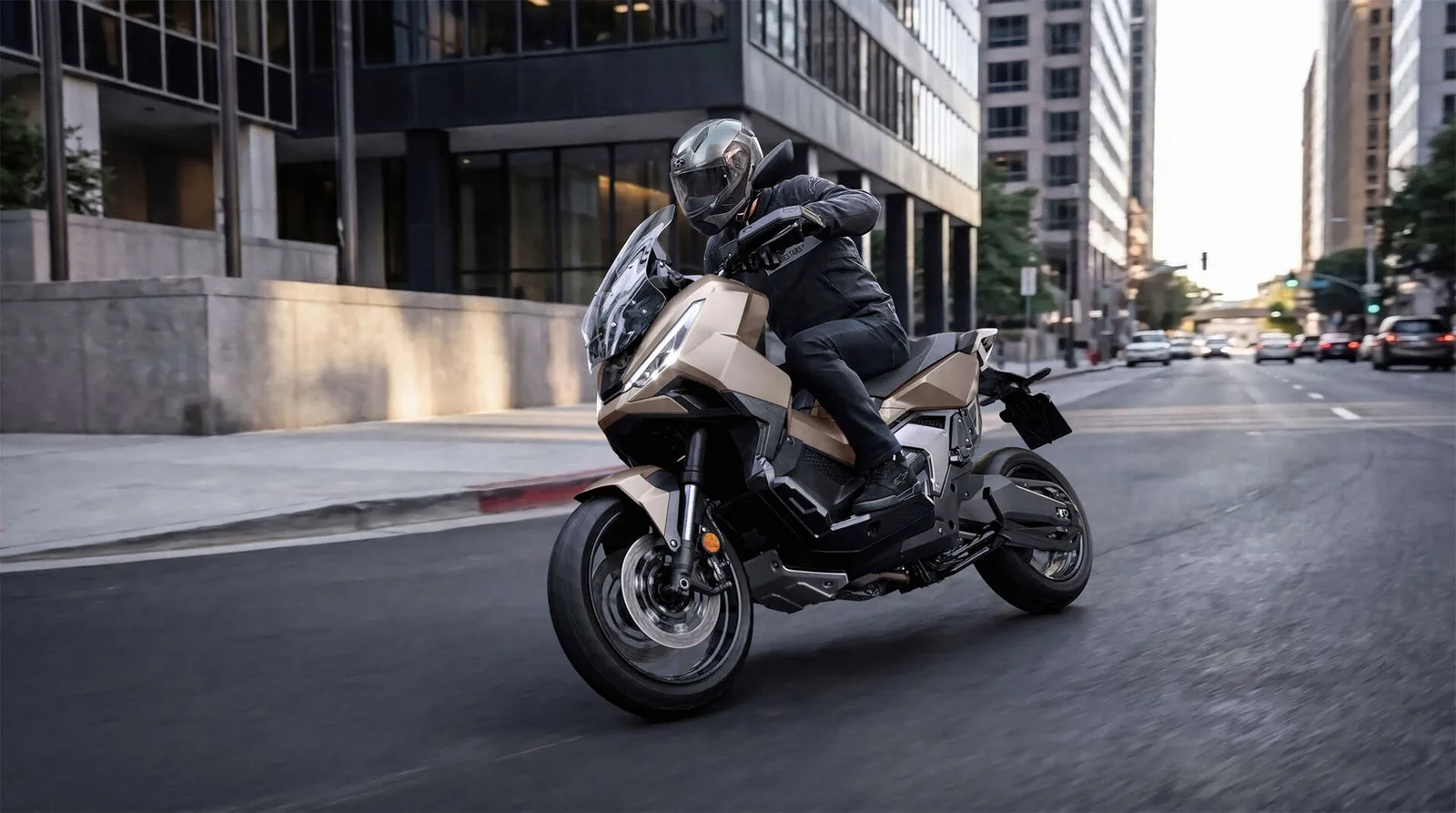
The tyres are Bridgestone Battlax Adventure block-pattern dual-purpose rubber, 120/70 R17 and 160/60 R15, on stainless-spoked wheels with L-shaped valve stems. Bennetts found them vague in the wet. Motorcycle.com and MCN both noted the suspension is soft and floaty on smooth roads and passes chop through on broken ones, which is partly the riding position: with your feet forward and all your weight on the seat, bumps go straight up your spine.
How it rides

Motorcycle News summed up the handling as pure motorcycle: stable in long corners, rolling into tighter turns with a steady sports-tourer lean rather than a sportsbike flick, thanks to the low centre of gravity. Visordown, which rode the launch in Sicily, called it an absolute riot to chuck around despite the weight, with a proper big-bike feel. The wide bars give leverage and the steering lock is good, but every tester said the same thing about traffic: it is long and wide, and squeezing through gaps that a Forza or an NC would take needs thought.
Weight is the recurring theme. At 237 kg with fuel it is heavier than an Africa Twin’s little brother has any right to be, and 1000PS found it awkward to manoeuvre by hand and wide to step through. On the move the weight disappears; at a standstill, on a camber, with a pillion, it does not. Bennetts’ tester with a 76 cm inside leg found the stand-over wide and the step-through high.
The ride quality divides on surface. Smooth roads are plush. Rough ones, and South Africa has plenty, send more through than a conventional bike would, and MCN said big potholes can be jarring. The Team-BHP rider made the same point. A taller aftermarket screen is the first thing most owners buy; the standard one is adjustable through 139 mm but the coverage is modest and Visordown found it rattles on rough roads.
Off the tar
The X-ADV is not an off-road bike, but it is far better on a gravel road than any scooter. The Gravel mode softens the throttle, lowers traction control and changes the DCT shift timing, and 150 mm of travel with 165 mm of clearance is enough for farm roads and forest tracks. Visordown rode light dirt in Sicily with confidence and said it can be twitched sideways and encouraged to spin the rear; 1000PS said colleagues on it kept up with adventure bikes on gravel trails.
The limits are the wheel sizes, the weight and the running boards. The Belgian test found the 17 and 15 inch wheels and the travel restrict it on anything rougher than a track. Standing up needs the optional flip-out pegs, and Visordown found the bodywork cuts into your legs when you do. Bennetts managed to dig it into a hotel’s gravel car park with traction control on in Standard mode, and rode out once Gravel mode was selected, which is the lesson: choose the mode before the gravel, not on it.
Electronics and equipment
Ride-by-wire gives four preset modes, Standard, Sport, Rain and Gravel, plus two User modes, each setting power delivery, engine braking, three-level traction control and the DCT shift map. ABS is two-channel and linked. Cruise control is new and works with the gearbox: in automatic it shifts up to top when you engage it, and a manual shift cancels it. There is a smart key for the ignition, fuel flap, seat and the optional top box, an emergency stop signal that flashes the hazards under hard braking, and self-cancelling indicators that work off wheel-speed difference, which one owner says is hit and miss without an inertial unit.
The 5 inch optically bonded TFT replaces the Africa Twin-style dash with cleaner graphics in Bar, Circle and Simple layouts. Honda RoadSync pairs a phone for turn-by-turn navigation, calls and music through a headset; an owner notes it cannot control streaming apps and there is no CarPlay. The switchgear is partly backlit and tidier than before, though Visordown found the new mode button small and hard to find by feel. Lighting is full LED, with twin projector headlights and the indicators integrated into the daytime running light strip, which Honda says is a production first.
Honda also makes a point of the materials: a bio-based Durabio plastic for the screen and side skirts, recycled polypropylene for several panels and recycled car bumpers for the luggage box and seat base, together about half the fairing. It is the first Honda motorcycle built that way.
Seat height, comfort and storage
The seat is 820 mm but tapered, and the 2025 bike added ten percent more foam. Feet-forward on running boards means there is endless legroom and nowhere to shift your weight, so all of it sits on the seat; MCN found the old bike could ache after two hours and the new one is better, with a comfort seat as an option that most owners seem to fit. One owner at 1.90 m reports 190 to 210 km between stretches on the comfort seat. Team-BHP’s rider at 1.78 m could flat-foot it; Bennetts’ shorter tester could not.
Under the seat is a 22 litre compartment with an LED light and a USB-C socket that takes a full-face helmet, plus a glovebox. The fuel flap opens from the key and the cap is loose, so you hold it while you fill. There is a centre stand as standard, hand guards and an aluminium bash plate. Five accessory packs cover panniers, a 50 litre top box, heated grips, fog lights, crash bars and the comfort seat; the Special Edition bundles the comfort and adventure packs with a two-tone livery.
Honda claims 3.6 litres per 100 km, which at 13.2 litres would be over 360 km. Real figures of around 4.3 give roughly 300 km, with the reserve light at about 230.
What owners say
Motorcycle News owners rate the 2025 bike 4.5 out of 5 across four reviews, and the pattern is familiar from the previous model: people buy it as a commuter and end up using it for everything. One came off a BMW R 1250 GS Adventure and ordered panniers for a 6,000 km Italian trip within weeks. Another rides a 2025 bike daily, averages 3.8 litres per 100 km, calls the gearbox a masterpiece and says the difference between Standard and Sport is night and day.
The complaints are specific. Plastics on one bike had paint runs and rough edges and the dealer was unhelpful. The same owner, a year and 16,000 km later, had warped front discs at 13,000 km that Honda treated as wear and tear, and a gearbox that had started lurching between third and fourth, which Honda said was normal. Several owners think heated grips and a heated seat should be standard at the price. One warns that the rear wheel throws water and road dirt onto the seat in the rain. The engine and DCT themselves draw no reliability complaints at all, and MCN rates the bike four out of five for reliability.
Price and availability in South Africa
Honda South Africa sold the previous X-ADV here, but the current showroom page does not list it, nor the Forza 750. The NC750X with the same engine and DCT is listed from R153,899 and the Transalp is on the page without a price. Honda dealers can usually order a model that Honda Motor Southern Africa carries in its range even when it is not on the website, so the first step is to ask one, and to ask what the delivery time is.
For an estimate, the UK X-ADV costs 31 percent more than the UK NC750X DCT. Applied to the local NC750X price that gives about R200,000, and the aggregator sites that guess South African prices land in the same place. Our estimate is R200,000 to R215,000 for a standard X-ADV if Honda brings in the 2026 model, and more for a Special Edition. Treat it as an estimate and confirm with a dealer; we will update this page when Honda South Africa publishes a figure.
Colours in Europe are Pearl Deep Mud Grey, Matte Warm Ash Metallic, Matte Ballistic Black Metallic and Grand Prix Red, with a Pearl Glare White Tricolor Special Edition. Honda South Africa’s choice, if it lists the bike, will be narrower.
What it costs to run
Petrol is at a record. The October 2026 adjustment took inland 95 unleaded to about R30 a litre. The X-ADV runs happily on 95, and with a 10.7:1 compression ratio it will tolerate 93 inland.
Honda claims 3.6 litres per 100 km. Bennetts averaged 4.3, Motorcycle News says owners see the low 4s and one owner reports 3.8. We have used 4.5 to be safe.
- A full 13.2 litre tank costs about R400.
- Range is roughly 290 km, with the reserve light on at about 230 km.
- Fuel costs about R1.35 a kilometre, among the lowest of any bike we have reviewed.
- A 40 km round-trip commute costs about R54 a day, or roughly R1,190 over 22 working days.
Services are every 12,000 km on the NC750 platform and the under-stressed engine is cheap to maintain; the DCT needs its own oil filter but no other special attention. Tyres are an odd pair, a 120/70 R17 and 160/60 R15, which limits choice but keeps the price down. Insurance should sit close to an NC750X’s. The costs that catch owners are the accessories: a top box, comfort seat, heated grips and taller screen add up quickly, which is why the Special Edition bundle exists.
Licence requirements in South Africa
South Africa has two motorcycle licence codes. Code A1 covers bikes up to 125cc from age 16. Code A covers everything else from age 18. The X-ADV is a 745cc motorcycle in law whatever it looks like, so it needs a full Code A, and a car licence does not cover it. The automatic gearbox makes no difference to the licence; there is no automatic-only code in South Africa.
As a first big bike it has a strong case. There is no clutch to stall, the power is soft, the Rain mode softens everything further, the brakes are linked and the seat is reachable. The weight is the thing to respect: 237 kg on a steep driveway or a gravel verge will catch out a new rider, and it is the one dynamic complaint every tester made. Our guide to what a motorbike licence costs in South Africa covers the fees and the tests.
X-ADV versus the alternatives
South African prices are the importers’ list prices at the time of writing and change often. The X-ADV figure is our estimate.
Honda NC750X DCT
R153,899 from Honda South Africa, and the closest thing to an X-ADV with footpegs. Same engine, same gearbox, a 23 litre storage bin in the false tank and a conventional riding position that handles South African potholes better. It is the sensible choice and about R50,000 cheaper on our estimate. The X-ADV buys you the under-seat boot, the suspension travel, the styling and the step-through.
Honda Transalp
Listed by Honda South Africa with the E-Clutch option and R20,000 off the 2025 model at the time of writing. The 755cc Hornet engine with 67 kW is the one every X-ADV tester wished for, in a proper adventure chassis with 21 inch front wheel. If gravel matters, this is the better bike; if the shopping matters, it is not.
Yamaha TMAX 560
About R229,951 from Yamaha dealers; Yamaha South Africa lists it without a price. The maxi-scooter benchmark: lighter, lower, sharper and quicker-steering than the X-ADV, with a CVT, and nowhere near it on gravel or in storage. Read our scooters for sale listings for what the used ones fetch.
Honda Forza 750
The X-ADV’s sibling, with the same engine, frame and DCT on 17 and 15 inch cast wheels, less travel, a lower seat and an electric screen. Bennetts recommends it over the X-ADV for pure road commuting. Honda South Africa does not list it.
Nothing else does what the X-ADV does. BMW’s C 400 GT is a 350cc scooter in a different class, and the Chinese 500cc maxi-scooters have no gravel pretensions. Start with the adventure bikes for sale on Scooter125 to see what the estimate buys among conventional bikes.
Full specifications
Figures from Honda UK and MotorcycleSpecs.co.za for the 2025 to 2027 X-ADV.
| Engine | 745cc liquid-cooled SOHC 8-valve 270-degree parallel twin |
| Bore x stroke | 77 x 80 mm |
| Compression ratio | 10.7:1 |
| Power | 43.1 kW (58 hp) at 6,750 rpm; 35 kW A2 version available |
| Torque | 69 Nm at 4,750 rpm |
| Fuel system | PGM-FI, ride-by-wire, Euro 5+ |
| Gearbox | 6-speed dual-clutch transmission, automatic D and S modes, manual with bar triggers, chain final drive |
| Frame | Tubular steel diamond, aluminium swingarm, Pro-Link |
| Front suspension | 41 mm Showa SFF-CA inverted fork, preload and rebound adjustable, 153 mm travel |
| Rear suspension | Showa monoshock, preload adjustable, 150 mm travel |
| Front brakes | Twin 296 mm discs, Nissin 4-piston radial calipers, linked ABS |
| Rear brake | 240 mm disc, single-piston caliper, linked ABS |
| Wheels and tyres | Wire-spoked 17 x 3.5 front and 15 x 4.5 rear; 120/70 R17 and 160/60 R15 |
| Rake and trail | 27 degrees, 104 mm |
| Wheelbase | 1,590 mm |
| Length x width x height | 2,215 x 940 x 1,370 mm |
| Seat height | 820 mm |
| Ground clearance | 165 mm |
| Kerb weight | 237 kg |
| Fuel tank | 13.2 litres |
| Claimed consumption | 3.6 litres per 100 km; testers saw about 4.3 |
| Storage | 22 litres under the seat with LED light and USB-C; glovebox |
| Electronics | Standard, Sport, Rain, Gravel and 2 User modes; 3-level traction control; cruise control; 5 inch TFT with Honda RoadSync; smart key; emergency stop signal; full LED |
| Top speed | 168 km/h, Honda claim |
| UK price | £11,499; Special Edition £12,799 |
| South African price | Not listed by Honda South Africa; our estimate R200,000 to R215,000 |
Frequently asked questions
How much is the Honda X-ADV in South Africa?
Honda South Africa does not list the current X-ADV. Based on the UK premium over the NC750X DCT, which is R153,899 here, our estimate is R200,000 to R215,000. Ask a Honda dealer whether it can be ordered.
Is the Honda X-ADV a scooter or a motorcycle?
Both. It has a scooter’s step-through, running boards and under-seat storage on a motorcycle’s frame, 17 and 15 inch wire wheels, long-travel suspension and a 745cc twin with a six-speed dual-clutch gearbox. In law it is a motorcycle and needs a Code A licence.
Does the X-ADV have a clutch?
Not a lever. Honda’s DCT uses two automatic clutches inside a six-speed gearbox. You ride it in automatic or shift with triggers on the left bar.
How fast is the Honda X-ADV?
Honda claims 168 km/h. Testers found 120 km/h effortless and motorway speeds relaxed, but it is a 43 kW bike and does not accelerate like a Transalp.
What changed on the 2025 X-ADV?
Smoother DCT at walking pace, cruise control, a 5 inch TFT with phone navigation, a thicker seat, a one-handed screen adjuster, new LED projector headlights with indicators in the running lights, new switchgear and partly plant-based and recycled bodywork. Engine and chassis are unchanged.
What is the seat height of the X-ADV?
820 mm, with a tapered seat. Riders of about 1.78 m report flat feet; shorter riders find the step-through high and the stand-over wide.
How much can the X-ADV carry?
22 litres under the seat, enough for a full-face helmet, plus a glovebox. A 50 litre top box and 26 and 33 litre panniers are accessories.
Is the X-ADV good off-road?
On gravel and farm roads, yes, with a Gravel mode, 150 mm of travel and 165 mm of clearance. On anything rougher the weight, wheel sizes and running boards limit it.
The verdict
The X-ADV is the most useful motorcycle Honda makes that almost nobody in South Africa has ridden. It commutes with a helmet in the boot and no clutch to work in traffic, tours with cruise control and 300 km of range on 13 litres, handles a gravel road to the farm, and does all of it on an engine that will outlast its owner. The 2025 update fixed the one thing that annoyed people, the walking-pace gearbox, and added the things they asked for. Owners who buy it to commute end up riding it to Italy.
The arguments against it are honest ones. It is heavy and wide, the engine is a worker rather than an entertainer, rough roads come through the seat, and on our estimate it costs R50,000 more than an NC750X that does most of the same job with footpegs. Nor is it in Honda South Africa’s current range, so buying one means a conversation with a dealer first.
If the idea of a motorcycle you never have to think about, with a boot, appeals, and you can get one, nothing else offers the combination. If you are not sure, ride an NC750X DCT first; it is the same bike underneath. Either way, look at the adventure bikes for sale on Scooter125 before you decide.
Sources referenced
- Honda UK, X-ADV overview and specification pages, 2026 and 2027 model years
- Honda Motor Co, Tech Views Vol. 1, “DCT and the X-ADV”
- MotorcycleSpecs.co.za, “2025 Honda X-ADV”: specification and 25YM press material
- Honda South Africa, motorcycles showroom: NC750X and Transalp listings, October 2026
- Motorcycle News, Simon Hargreaves, “2025-on Honda X-ADV 750 review”, updated 7 February 2025, and owner reviews to October 2026
- Bennetts BikeSocial, Luke Brackenbury, “Honda X-ADV (2025) review”, 16 December 2025
- Visordown, Matt Robinson, “2025 Honda X-ADV review”, 2 November 2024; Al Dowds, long-term test, 2024
- 1000PS, “Honda X-ADV 2025 review: scooter meets adventure”, 27 June 2025
- Team Throttle, Jan F, “Review: Honda X-ADV”, 30 September 2019
- Team-BHP forum, “Test riding the Honda X-ADV 750”, May to October 2025
- Honda Motorcycles Europe, “2026 X-ADV Special Edition” video
- Department of Mineral and Petroleum Resources, October 2026 fuel price adjustment