Ducati Diavel V4 RS (2026) Review: The Panigale-Engined Cruiser, 0 to 100 in 2.5 Seconds and What It Would Cost in South Africa
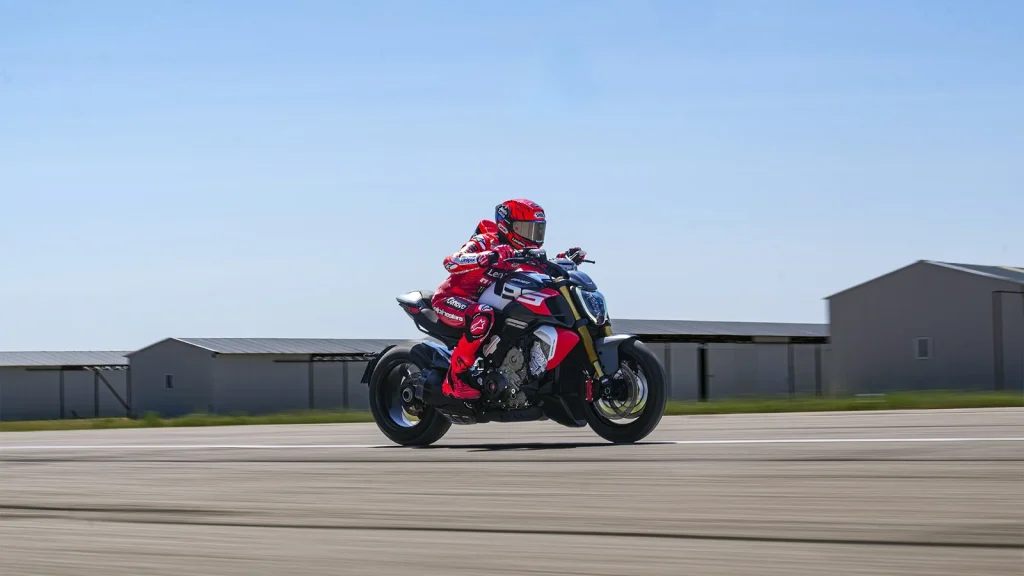
Ducati launched the Diavel V4 RS by handing it to Marc Marquez on an airstrip and timing him from a standstill to 100 km/h. He did it in 2.5 seconds. Ducati’s own test rider later did 2.4, which makes this the fastest-accelerating road bike Ducati has built, quicker off the line than a Panigale V4 because a 1,602 mm wheelbase and a 240-section rear tyre keep the front wheel down while 133.8 kW from the Panigale’s Desmosedici Stradale engine tries to lift it. Motorcycle News said it pushes your eyeballs into your skull.
It costs £34,396 in Britain, which is £10,000 more than the Diavel V4 it is built from, and Ducati South Africa publishes no price for either. This review covers what the RS adds, what the superbike engine does and does not do in a cruiser, how it rides according to the one full road test so far, what it would cost to run on Highveld fuel, and what else that kind of money buys in South Africa.
This is a research based review. Scooter125 has not ridden the Diavel V4 RS and the bike was not supplied by Ducati or a dealer. Specifications come from Ducati, MotorcycleSpecs.co.za and British dealer listings. Riding impressions come from Michael Neeves’ Motorcycle News test, with analysis from Bennetts BikeSocial and Visordown and South African context from Ride Fast. South African pricing is our estimate and is labelled as such. The running cost sums are our own, at the October 2026 fuel price.
What you need to know first
The Diavel V4 RS is the first Diavel with Ducati’s superbike engine. The 1,103cc Desmosedici Stradale V4 from the Panigale and Streetfighter, with desmodromic valves and a counter-rotating crank, replaces the standard Diavel V4’s 1,158cc spring-valve Granturismo. It makes 133.8 kW (182 hp) at 11,750 rpm and 120 Nm at 9,500 rpm, against the standard bike’s 124 kW and 126 Nm, and revs to 13,500 rpm. It drives through a billet STM dry slipper clutch and a six-speed box with an up-and-down quickshifter, with gearing long enough to reach 100 km/h in first.
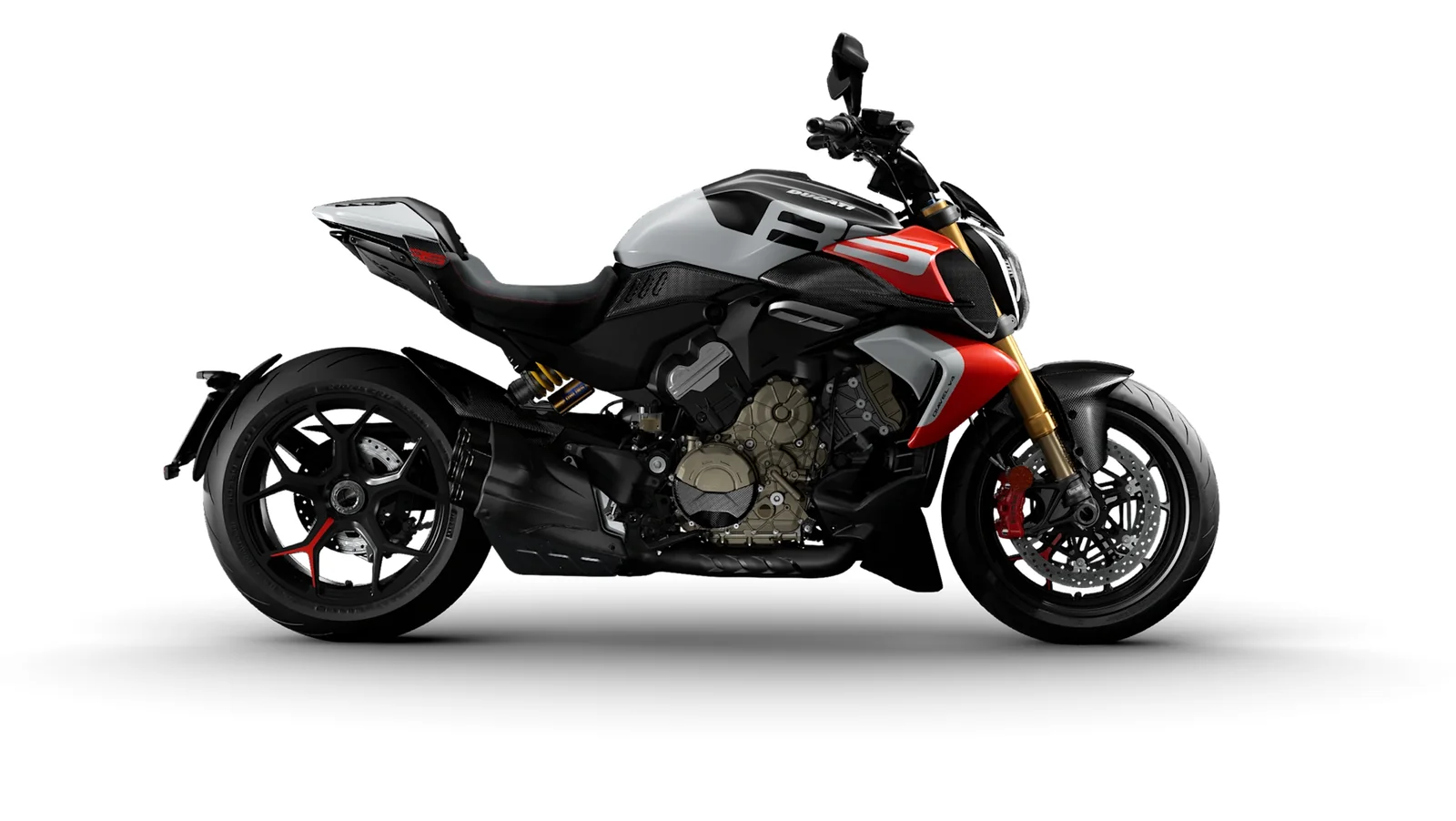
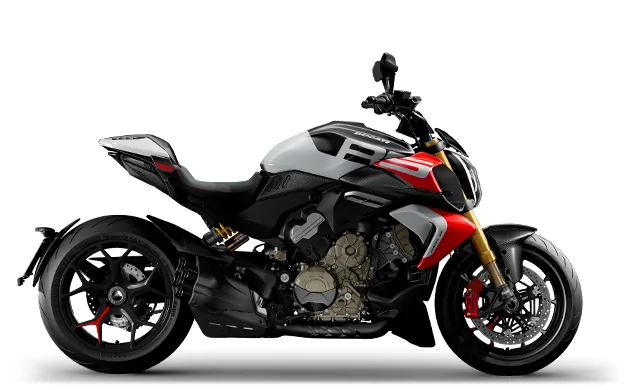
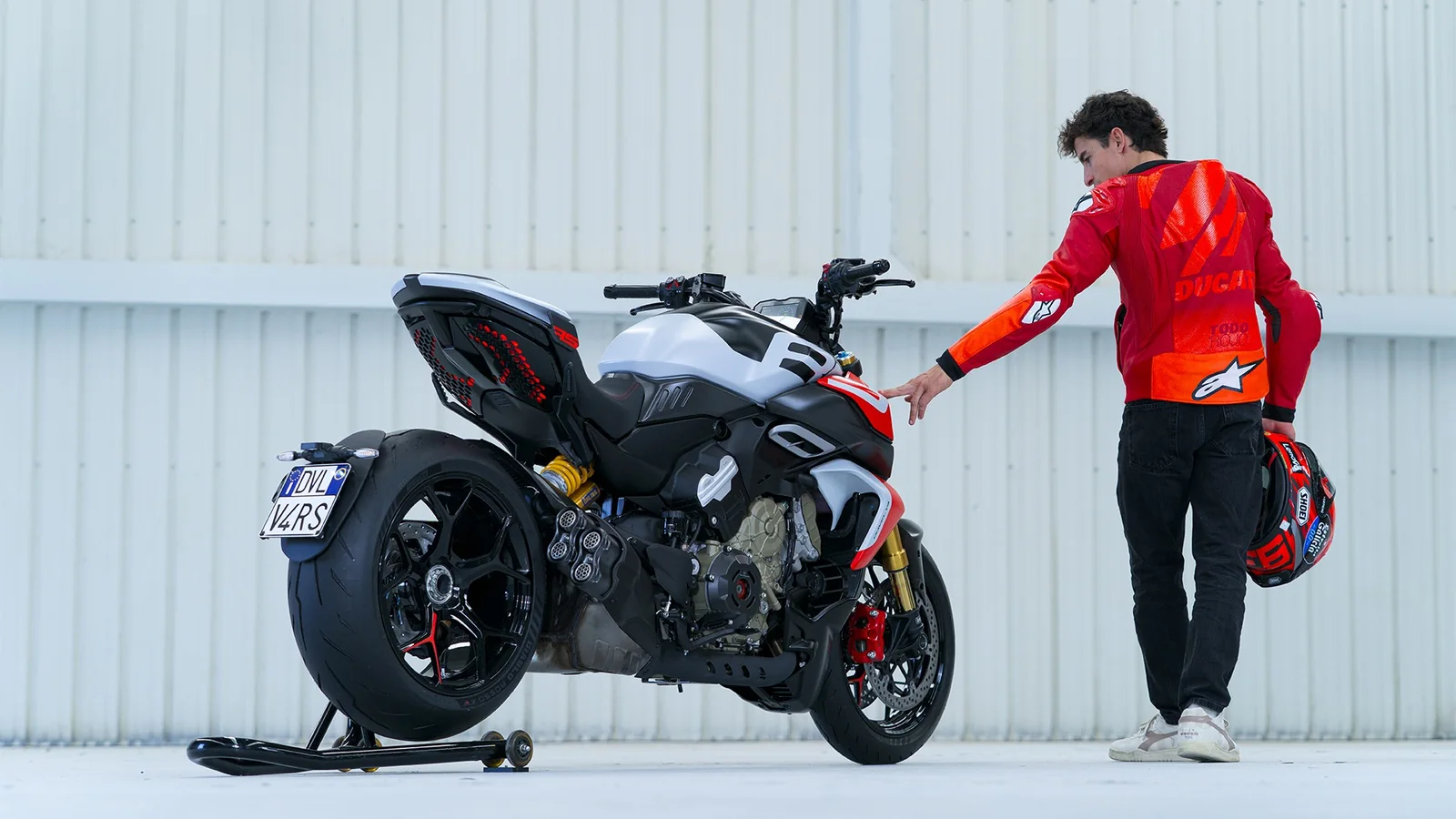
Around it Ducati fitted a fully adjustable 48 mm Öhlins NIX30 fork and STX46 shock, forged aluminium Y-spoke wheels, Brembo Stylema calipers on 330 mm discs, carbon fibre intakes, mudguards, tank covers and a single-seat tail, a lithium battery, titanium exhaust tips and a numbered plate on the cylinder head. The weight saving is 3 kg; the bike is 220 kg without fuel, the seat 790 mm, the tank 20 litres. Electronics add a Race riding mode, a first for the Diavel, and a three-level Ducati Power Launch. The two-seat kit is in the crate.
Motorcycle News gave it four stars and called the acceleration brain-melting, the handling impressively capable for such a long, fat-tyred bike, and the braking as brutal as the acceleration. Its reservations were the price, the weight when pushed in corners, engine heat, a small dash with semi-backlit switchgear, heated grips as an extra, and the fact that the standard Diavel V4 gives more or less the same experience for £10,000 less. Bennetts added that the RS has less torque than the standard bike and a higher-revving engine, so it may have less instant punch in gear.
What the Diavel V4 RS is
The Diavel arrived in 2011 as Ducati’s answer to a question nobody had asked: what if a cruiser handled like a naked bike? It worked, through a 1,200cc V-twin and then the 2023 Diavel V4 with the Granturismo engine. What the V4 never had was an S version with Öhlins, which every other Ducati gets. The RS is that, and more: Ducati did not just upgrade the suspension, it swapped in the engine from its superbike, the way it did with the Multistrada V4 RS in 2024.
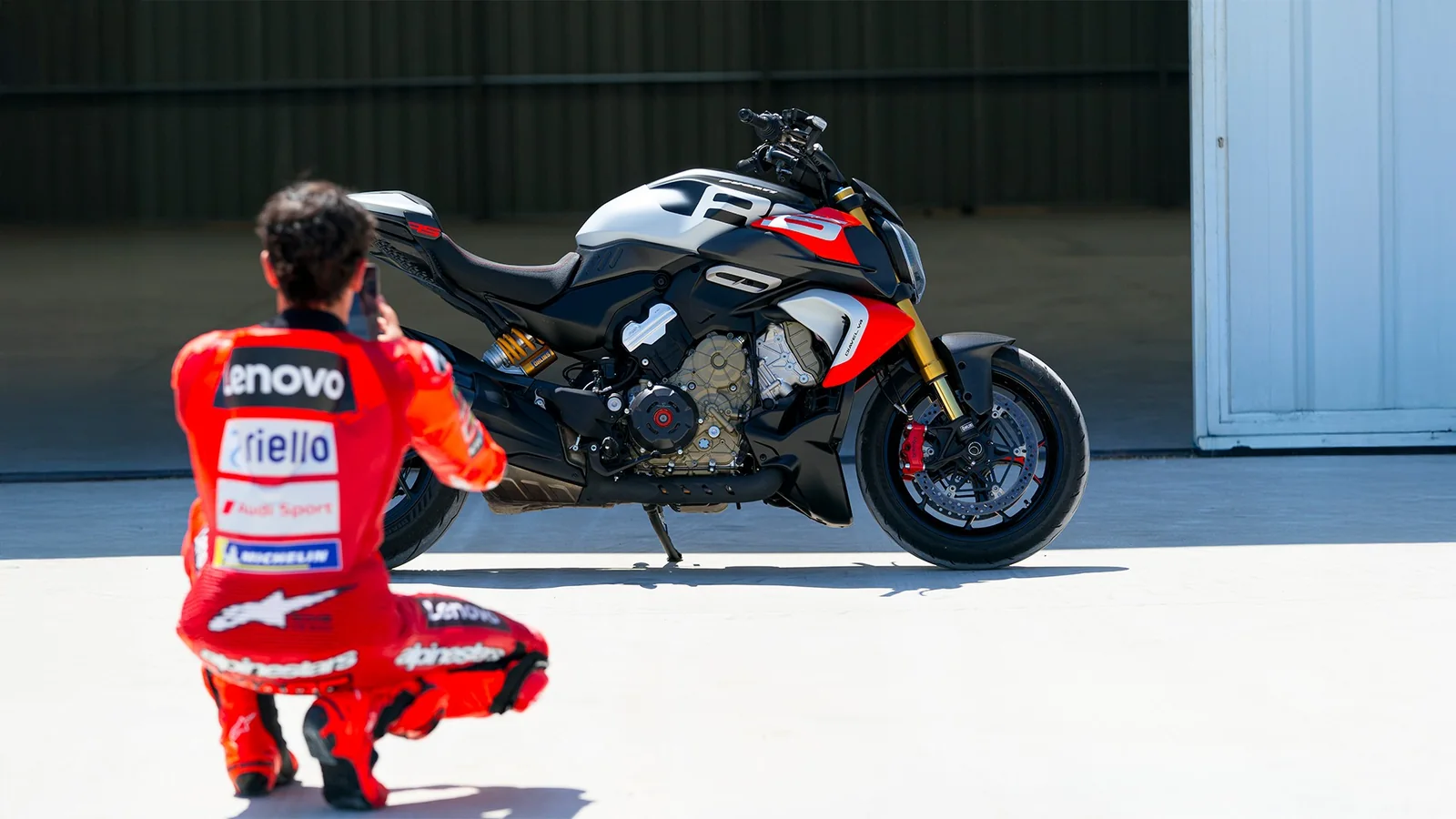
The design is Ducati’s usual RS recipe. A single livery in black, grey and red with the RS lettering across the tank, carbon where the standard bike has plastic, red Brembo calipers, a laser-etched RS on the key, the dash and the rear cylinder cover, a start-up animation, and a production number on each bike without a cap on how many are built. Bennetts’ view was that the RS plugs the gap the missing S left and, with the Desmosedici engine, becomes a distinct model in its own right.
The Desmosedici Stradale in a cruiser
The Desmosedici Stradale is a 1,103cc, 90 degree V4 with an 81 mm bore, 53.5 mm stroke, 14:1 compression, desmodromic valve closing, a counter-rotating crankshaft and Ducati’s twin-pulse firing order, fed by twin injectors per cylinder through 50 mm elliptical ride-by-wire throttle bodies. In the Panigale it makes 216 hp; in the Diavel it is tuned to 182 hp at 11,750 rpm and 120 Nm at 9,500 rpm, which Bennetts pointed out leaves Ducati plenty of room. It is 1.8 kg lighter than the Granturismo and the rear cylinder bank shuts off at idle in neutral to spare the rider’s legs.
Motorcycle News described opening the throttle as an assault on the senses: a deep, hollow airbox roar and brutal acceleration that never relents, even in sixth. And then, in the same breath, it called the engine civilised, with mapping refined enough that the RS is as easy to bimble through town as it is to rinse anything away from the lights. The dry clutch is a billet STM-EVO SBK slipper unit, the kind Ducati fits to its race bikes, and the gearing is unique to the RS.
The trade-off is the one Bennetts flagged. The Granturismo makes 126 Nm at 7,500 rpm; the Desmosedici makes 120 Nm at 9,500. The RS has more power and less torque, higher up, so the standard Diavel may feel punchier at low revs in a high gear. And the valve-check interval drops from 60,000 km on the Granturismo to 30,000 km on the Desmosedici, which MCN called the price of the extra performance. At Highveld altitude a naturally aspirated engine loses roughly 15 percent, so in Gauteng this is about a 114 kW motorcycle, which is still more than any cruiser has a right to.
Launch control and the 2.5 second claim
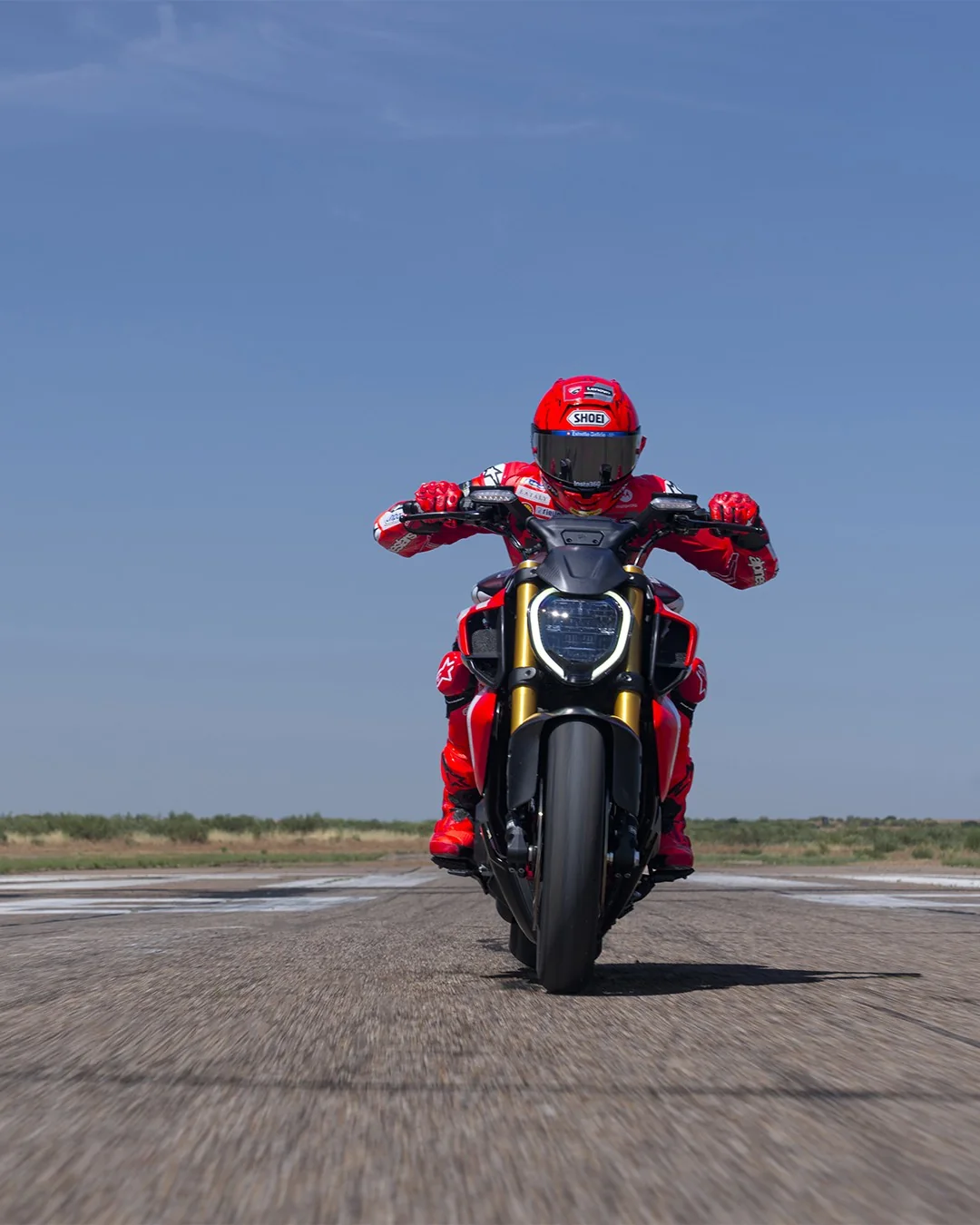
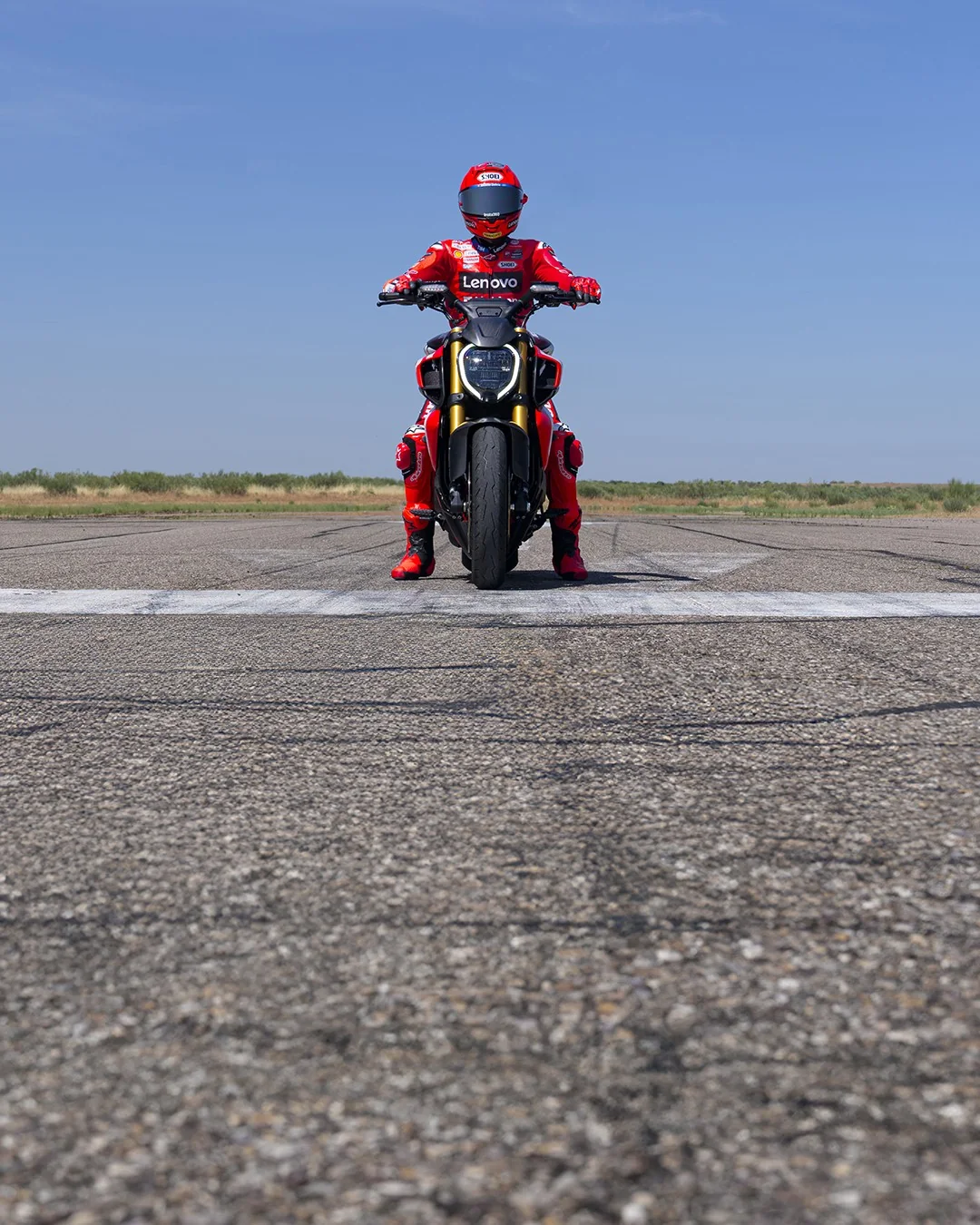
Ducati Power Launch has three levels. You hold the throttle wide open, the dash pulses red, the electronics hold the revs, and all you do is release the clutch; an algorithm then limits how many consecutive launches you can make to protect that clutch. MCN’s description of the result is the reason to read its review: unless you have ridden a drag bike or started a MotoGP race, you will never have felt such G-force from a standing start.
The physics are in the geometry. A 1,602 mm wheelbase is 194 mm longer than a Panigale V4 S and 117 mm longer than a Hayabusa, the 240/45 rear tyre is the widest Pirelli makes, and the wheelie control lets you keep the throttle pinned while the front hovers. Ducati’s claim is 2.5 seconds to 100 km/h, set by Marquez at the launch; MCN reports test rider Alessandro Valia at 2.4, and that first gear is long enough to reach 100 without a shift. Visordown’s caveat is the correct one: those are factory riders on a prepared surface, and the number is not a promise.
Öhlins, forged wheels and Stylema brakes
The aluminium monocoque frame, with the engine as a stressed member, the steel trellis subframe and the single-sided aluminium swingarm carry over from the standard bike, as do the 26 degree rake and 112 mm of trail. The suspension is the RS’s reason to exist: a 48 mm Öhlins NIX30 fork with 120 mm of travel and an Öhlins STX46 shock with 145 mm, both fully adjustable, replacing the standard bike’s 50 mm non-adjustable fork and preload-only shock. Ducati says the settings are firmer and sportier; MCN found the ride plush.
The wheels are new five-spoke forged aluminium Y-spokes, 3.5 inches at the front and a full 8 inches at the rear, on Pirelli Diablo Rosso IV in 120/70 and 240/45. The brakes are Brembo Stylema four-piston monoblocs on 330 mm semi-floating discs with a radial master cylinder, a 265 mm rear with a two-piston Brembo, and Bosch cornering ABS. MCN said the long wheelbase lets the Stylemas be used to their full, devastating effect, and warned that they are strong enough to plough the front tyre and trigger the ABS if the rubber is cold.
How it rides
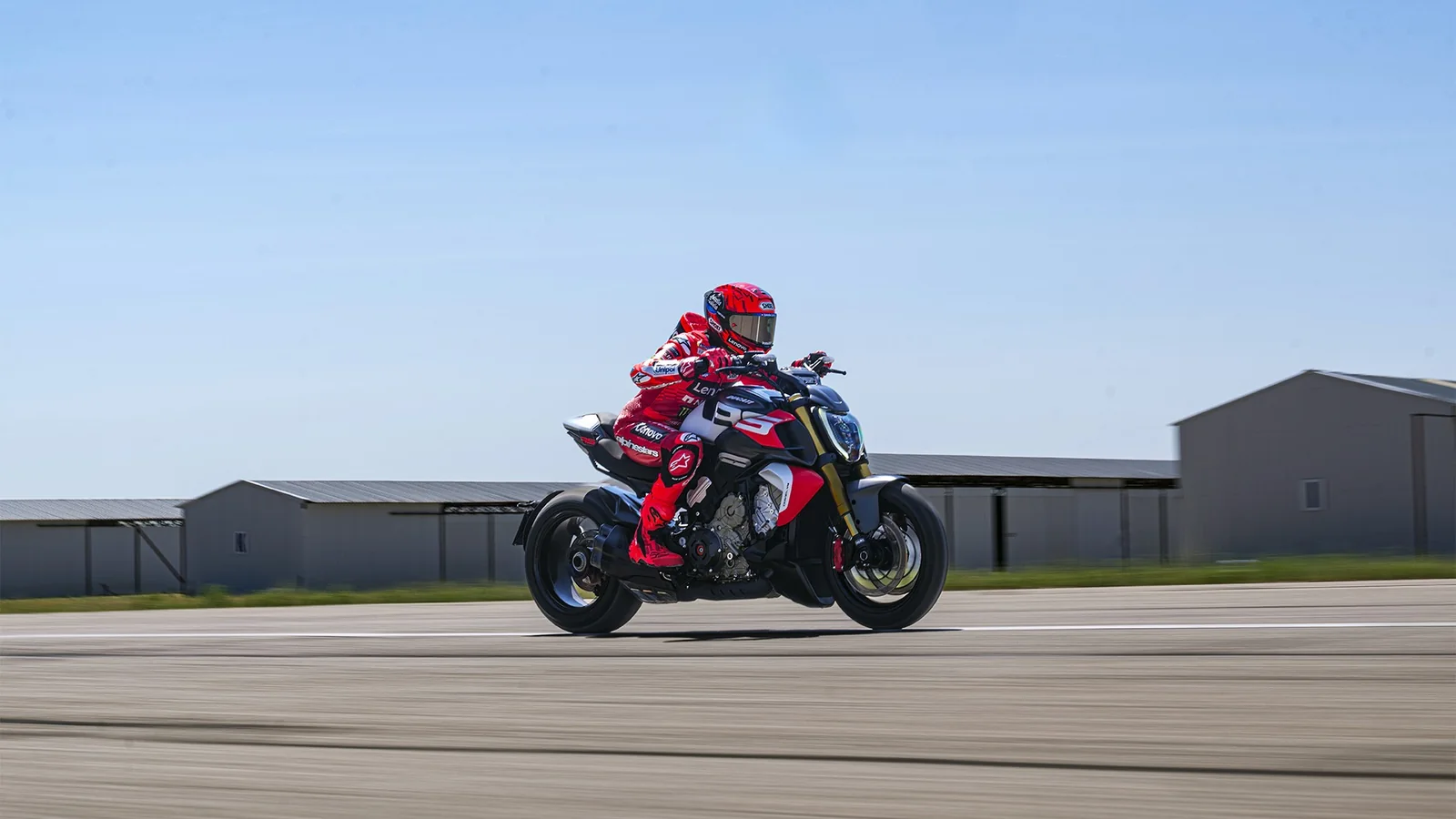
MCN’s Michael Neeves summed up the cornering in a phrase: it corners like a stretched super-naked. At normal speeds the handling is crisp and accurate and the bike carries its weight well. Push on and the 220 kg makes itself known: you wait for the weight to settle before committing to a bend, especially over bumps, and you exercise patience while the 240 rear rolls onto its side. The Diavel responds best, he found, when finessed with fingertips and helped round with generous back brake, and ridden that way it glides through corners with little effort.
Despite its stature the bike feels small and light, the riding position is spacious and the stitched seat comfortable, and the 790 mm seat puts both feet flat. The grip from the Diablo Rosso IVs is plentiful and the ride is plush. Neeves’ verdict was that the RS is not only fast in a straight line but impressively capable on a back road for such a beastly machine, and that it is as easy to ride through town admiring your reflection as it is to destroy anything at a traffic light.
Electronics and equipment
A Bosch six-axis inertial unit runs lean-sensitive traction control, wheelie control, cornering ABS and the DQS 2.0 up-and-down quickshifter, each tied to the riding modes. Race, Sport and Touring give full power with different throttle responses; Wet drops to about 85 kW. Race mode is new to the Diavel and brings a Track Info display on the 5 inch TFT that records 0 to 100 and 0 to 200 km/h times. Cruise control, keyless ignition, turn-by-turn navigation through the Ducati Multimedia System, a USB port, full LED lighting with cornering lights and dynamic indicators are standard.
MCN’s complaints were small and specific: the dash is small next to other Ducati V4s, though perfectly formed and in keeping with the Diavel’s minimal layout, the switchgear is only semi-backlit, and heated grips cost extra on a bike at this price. Bennetts’ was that the single graphics-heavy livery will not suit everyone.
Seat height, comfort and heat
The seat is 790 mm, low for a bike with this much performance, and the wide bar and forward pegs give a cruiser stance with enough room for a tall rider. The single seat has a generously sized bum stop, which MCN noted is there to stop you falling off the back under acceleration, and the two-up kit with pillion seat and pegs is supplied. There is no screen and no wind protection; a 20 litre tank is the only touring concession.
Heat is the honest caveat. MCN said the V4 pumps out a lot of it even with the rear-cylinder cut at idle, which is a Panigale trait and a summer-in-Durban consideration. The bike has no luggage, no screen and 30,000 km valve services; it is a weekend and Sunday-morning motorcycle that happens to be comfortable, not a tourer.
Price and availability in South Africa
Ducati South Africa lists both the Diavel V4 and the Diavel V4 RS on its website, with specifications but no prices, and directs buyers to the configurator or a dealer. The RS reached European dealers in December 2025 and other markets from January 2026, and Ride Fast covered its arrival locally without a rand figure. World of Motorcycles, the Ducati dealer, was advertising a 2026 Diavel V4 Dark at R493,000 and an XDiavel V4 at R518,000 in October 2026, which is the best local anchor we have.
In Britain the RS costs £34,396 against £24,595 for the standard Diavel V4, a premium of about 40 percent, and in the United States it is $39,990. Applying the British premium to the local Diavel V4 price gives roughly R690,000. Our estimate is R650,000 to R700,000, and we will update this page when a dealer quotes a figure. Ask about the two-seat kit, which is included, and heated grips, which are not.
What it costs to run
Petrol is at a record. The October 2026 adjustment took inland 95 unleaded to about R30 a litre. The Desmosedici Stradale runs 14:1 compression and Ducati specifies 98 RON; inland 95 is the best available and the engine’s knock control will manage it, but 93 is not an option.
Nobody has published a consumption figure for the RS, and the Panigale engine it uses is not a frugal one. We have used 7.5 litres per 100 km as a realistic mixed figure.
- A full 20 litre tank costs about R600.
- Range is roughly 265 km, and the fuel light will come on well before that.
- Fuel costs about R2.25 a kilometre, the highest of any bike we have reviewed.
- A 40 km round-trip commute costs about R90 a day, or roughly R1,980 over 22 working days, if anyone commutes on one.
Services are every 15,000 km with desmodromic valve checks at 30,000, half the Granturismo’s interval and a Ducati-dealer job. A 240/45 rear tyre in a sports compound is expensive and short-lived under 120 Nm and launch control. Insurance on a R700,000 motorcycle will be substantial. The dry clutch is a race part and will wear faster than a wet one if the launch control gets used the way Ducati intends.
Licence requirements in South Africa
South Africa has two motorcycle licence codes. Code A1 covers bikes up to 125cc from age 16. Code A covers everything else from age 18. The Diavel V4 RS needs a full Code A, and a car licence does not cover it.
It is not a first bike, however low the seat and however friendly the Wet mode. It is 220 kg and 134 kW with a launch control system, and MCN’s advice about waiting for the weight to settle in corners is advice for an experienced rider. Our guide to what a motorbike licence costs in South Africa covers the fees and the tests.
Diavel V4 RS versus the alternatives
South African prices are importers’ list prices, ZA Bikers buyers guide figures or dealer prices at the time of writing and change often. The Ducati RS figure is our estimate.
Ducati Diavel V4
About R493,000 as a 2026 Dark at World of Motorcycles. The same frame, wheelbase and 240 rear with the 124 kW Granturismo, more torque lower down, 60,000 km valve intervals and non-adjustable suspension. MCN’s verdict was that it gives more or less the same riding experience for far less money. It is the rational choice; the RS is the other kind.
BMW M 1000 R
R404,250 from BMW Motorrad South Africa according to ZA Bikers. A 154 kW superbike-engined naked at 199 kg, with winglets, M brakes and a shorter wheelbase. It is faster everywhere except off the line, where the Diavel’s length wins, and it is R250,000 cheaper on our estimate. Read our BMW M 1000 XR review for the engine.
Triumph Rocket 3 Storm
From R460,000 for the Storm GT at Triumph South Africa. The 2,458cc triple makes 134 kW and 225 Nm, nearly twice the Ducati’s torque, at 317 kg. It is the other superbike-engined cruiser idea, done with displacement instead of revs, and it is the more comfortable bike by a distance.
Ducati Streetfighter V4 S
The same engine in Ducati’s naked, with 214 hp, Öhlins semi-active suspension and 50 kg less weight. Ducati South Africa lists it without a price. It is the bike for anyone whose question is speed rather than spectacle.
Kawasaki Z H2 SE and MV Agusta Brutale 1000 RR
The rivals Bennetts named in Britain. Neither has a current South African importer price we could confirm.
Start with the cruisers for sale and the superbikes for sale on Scooter125, where R700,000 buys a great deal of either.
Full specifications
Figures from Ducati and MotorcycleSpecs.co.za for the 2026 Diavel V4 RS.
| Engine | 1,103cc Desmosedici Stradale 90-degree V4, desmodromic 16-valve, counter-rotating crankshaft, twin-pulse |
| Bore x stroke | 81 x 53.5 mm |
| Compression ratio | 14.0:1 |
| Power | 133.8 kW (182 hp) at 11,750 rpm |
| Torque | 120 Nm at 9,500 rpm |
| Fuel system | Twin injectors per cylinder, 50 mm elliptical ride-by-wire throttle bodies; Euro 5+ |
| Clutch | STM-EVO SBK billet dry multiplate slipper clutch |
| Gearbox | 6-speed, Ducati Quick Shift 2.0 up and down, 16/43 final drive, RS-specific ratios |
| Frame | Aluminium monocoque with engine as stressed member, steel trellis subframe, single-sided aluminium swingarm |
| Front suspension | 48 mm Öhlins NIX30 fork, fully adjustable, 120 mm travel |
| Rear suspension | Öhlins STX46 monoshock, fully adjustable, 145 mm travel |
| Front brakes | Twin 330 mm semi-floating discs, Brembo Stylema 4-piston monobloc radial calipers, radial master cylinder |
| Rear brake | 265 mm disc, Brembo 2-piston floating caliper |
| ABS | Bosch-Brembo cornering ABS |
| Wheels | Forged aluminium Y-spoke, 3.5 x 17 front, 8.0 x 17 rear |
| Tyres | Pirelli Diablo Rosso IV, 120/70 ZR17 and 240/45 ZR17 |
| Rake and trail | 26 degrees, 112 mm |
| Wheelbase | 1,602 mm |
| Seat height | 790 mm |
| Weight | 220 kg wet without fuel |
| Fuel tank | 20 litres |
| Electronics | Bosch IMU; Race, Sport, Touring and Wet modes; High, Medium and Low power modes; DTC, DWC, cornering ABS, DQS 2.0, Ducati Power Launch (3 levels); cruise control; keyless; 5 inch TFT with Track Info; Ducati Multimedia System; USB; full LED with cornering lights |
| Claimed performance | 0 to 100 km/h in 2.5 seconds |
| Colours | RS livery only; numbered |
| UK price | £34,396 |
| US price | $39,990 |
| South African price | Not published; our estimate R650,000 to R700,000 |
Frequently asked questions
How much is the Ducati Diavel V4 RS in South Africa?
Ducati South Africa has not published a price. It costs £34,396 in Britain and $39,990 in the United States, about 40 percent more than a standard Diavel V4, which a local dealer lists at R493,000. Our estimate is R650,000 to R700,000.
How fast is the Ducati Diavel V4 RS?
Ducati claims 0 to 100 km/h in 2.5 seconds, set by Marc Marquez at the launch, with its test rider recording 2.4. It is Ducati’s fastest-accelerating road bike. Top speed is not published.
What engine is in the Diavel V4 RS?
The 1,103cc Desmosedici Stradale V4 from the Panigale and Streetfighter, tuned to 182 hp and 120 Nm, with a dry slipper clutch. The standard Diavel V4 uses the 1,158cc Granturismo with 168 hp.
What is the difference between the Diavel V4 and the Diavel V4 RS?
The RS has the superbike engine, fully adjustable Öhlins suspension, forged wheels, carbon bodywork, a lithium battery, a dry clutch, a Race mode and launch control, titanium exhaust tips and a numbered plate. It is 3 kg lighter and costs about 40 percent more.
What is the seat height of the Diavel V4 RS?
790 mm. Motorcycle News found it low enough to get both feet flat.
How heavy is the Diavel V4 RS?
220 kg without fuel, about 235 kg with the 20 litre tank full.
What are the service intervals on the Diavel V4 RS?
15,000 km or 24 months for services, with desmodromic valve checks every 30,000 km, half the standard Diavel V4’s 60,000 km.
Does the Diavel V4 RS take a pillion?
Yes. It is delivered as a single-seater with a carbon tail, and the pillion seat and footpegs are supplied in the kit.
The verdict
The Diavel V4 RS is the most extreme version of an idea Ducati has been refining for fifteen years, and the testers who rode it found the execution beyond fault: the fastest-accelerating road bike Ducati makes, with handling that belies its length and weight, brakes to match the engine, Öhlins that finally give the Diavel the suspension it deserved, and a level of finish that MCN called decadence overload.
The argument against it is the one MCN made itself. The standard Diavel V4 does almost everything the RS does, with more torque where you use it, double the valve interval and, on our estimate, R200,000 in your pocket. The RS costs a BMW M 1000 R plus a Honda NC750X, needs 98 octane it cannot get inland, runs hot and wears its rear tyre like a consumable.
If you want the ultimate in what MCN called luxurious, brain-melting acceleration, and want to be, in its phrase, traffic light grand prix champion forevermore, nothing else does this. If you want a Diavel, buy the V4. Either way, start with the cruisers for sale on Scooter125, and we will update this review the day a rand price appears.
Sources referenced
- Ducati South Africa, Diavel V4 RS and Diavel V4 model pages; Ducati worldwide Diavel V4 RS page
- MotorcycleSpecs.co.za, “2026 Ducati Diavel V4 RS”: specification table
- Motorcycle News, Michael Neeves, “2026-on Ducati Diavel V4 RS review”, updated 16 June 2026
- Bennetts BikeSocial, Ben Purvis, “Ducati Diavel V4 RS (2026) review”, 12 September 2025
- Visordown, “2026 Ducati Diavel V4 RS price, spec and features”, September 2025
- Ride Fast, “The 2026 Ducati Diavel V4 RS: luxury meets track tech”
- Seastar Superbikes, UK dealer listing; World of Motorcycles, South African Ducati dealer listings; ZA Bikers buyers guide for the BMW M 1000 R; Triumph South Africa price list
- Department of Mineral and Petroleum Resources, October 2026 fuel price adjustment