Kawasaki Z650RS Review: The Modern Classic 650, Specs and South African Price
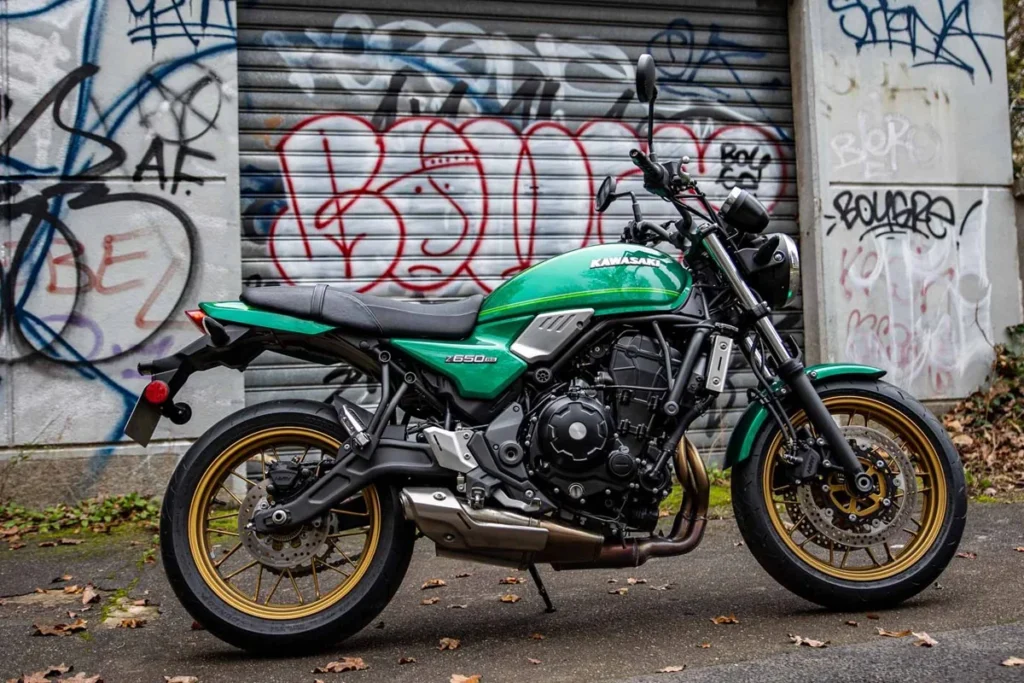
The Kawasaki Z650RS is a modern motorcycle dressed as a 1970s one. Under the teardrop tank, twin clocks and gold spoke-style wheels is the 649cc parallel twin from the Z650 and Ninja 650, one of the most reliable and easy-going engines in motorcycling, in a light steel trellis frame with modern brakes and ABS. It weighs 187 kg with fuel and makes 50.2 kW.
Kawasaki South Africa sells it, and at the moment it sells it at a discount: the 2023 model in Candy Emerald Green is listed at R169,990, down from R174,995. That puts it right in the middle of the Royal Enfield 650s and below the CFMoto 700CL-X Heritage. This review covers what the Z650RS is, how it compares with the bike it is styled on, what the testers found, what it costs to run, and whether to buy the discounted 2023 bike or wait for a newer one.
This is a research based review. Scooter125 has not ridden the Z650RS and the bike was not supplied by Kawasaki or a dealer. Specifications come from Kawasaki Motors South Africa, Kawasaki Europe and Kawasaki USA. Riding impressions come from Kawasaki South Africa’s own first ride, Classic Motorcycle Mechanics’ back-to-back test against an original Z650, and Billy’s Bikes, with background from ZA Bikers, Gear Patrol, BikeDekho, Webike and UK dealer Seastar Superbikes. South African prices are from Kawasaki South Africa, Royal Enfield South Africa and ZA Bikers in October 2026. The running cost sums are our own, at the October 2026 fuel price.
What you need to know first
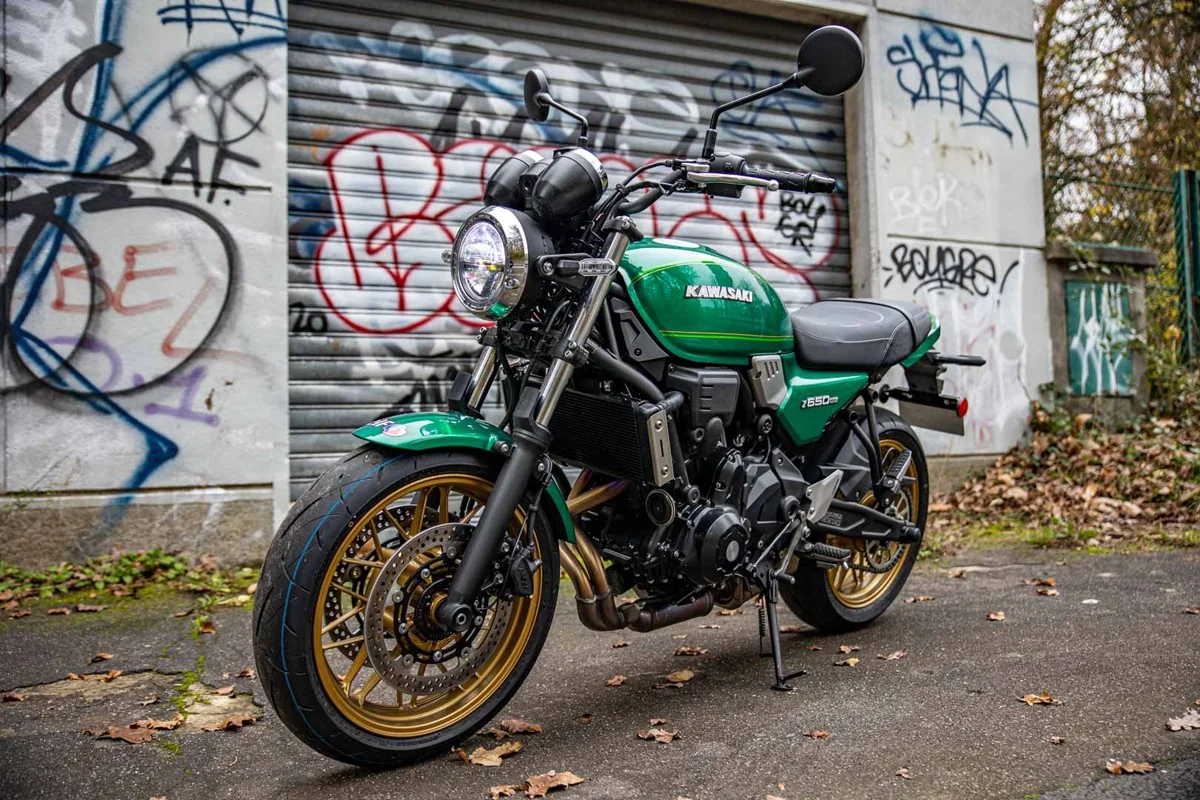
The Z650RS uses a liquid-cooled, eight-valve, 649cc parallel twin making 50.2 kW (68 PS) at 8,000 rpm and 64 Nm at 6,700 rpm, with a six-speed gearbox, an assist and slipper clutch and chain drive. The frame is a high-tensile steel trellis, the fork is a conventional 41 mm unit, the shock works through a horizontal back-link with adjustable preload, and the brakes are twin 300 mm front discs with ABS. It weighs 187 kg full of fuel, the tank holds 12 litres, and Kawasaki South Africa claims 4.3 litres per 100 km.
Kawasaki South Africa lists the 2023 model in Candy Emerald Green at R169,990, reduced from R174,995. In Britain the current bike is £7,899, in America the 2027 model is $8,999, and in India it is about ₹7.83 lakh. Newer European and American bikes add two-mode traction control, which the 2023 South African specification does not list.
The testers agree on what it is. Kawasaki South Africa’s first ride called the handling neutral yet lively and the engine smooth and usable, and concluded there is little direct competition. Classic Motorcycle Mechanics found it pulls harder, stops far better and weighs 33 kg less than the original it imitates, though the old bike has more presence. The criticisms are consistent: a 12 litre tank gives a short range, there is no wind protection, the pillion seat is small, and grab rails cost extra.
From the 1976 Z650 to the Z650RS
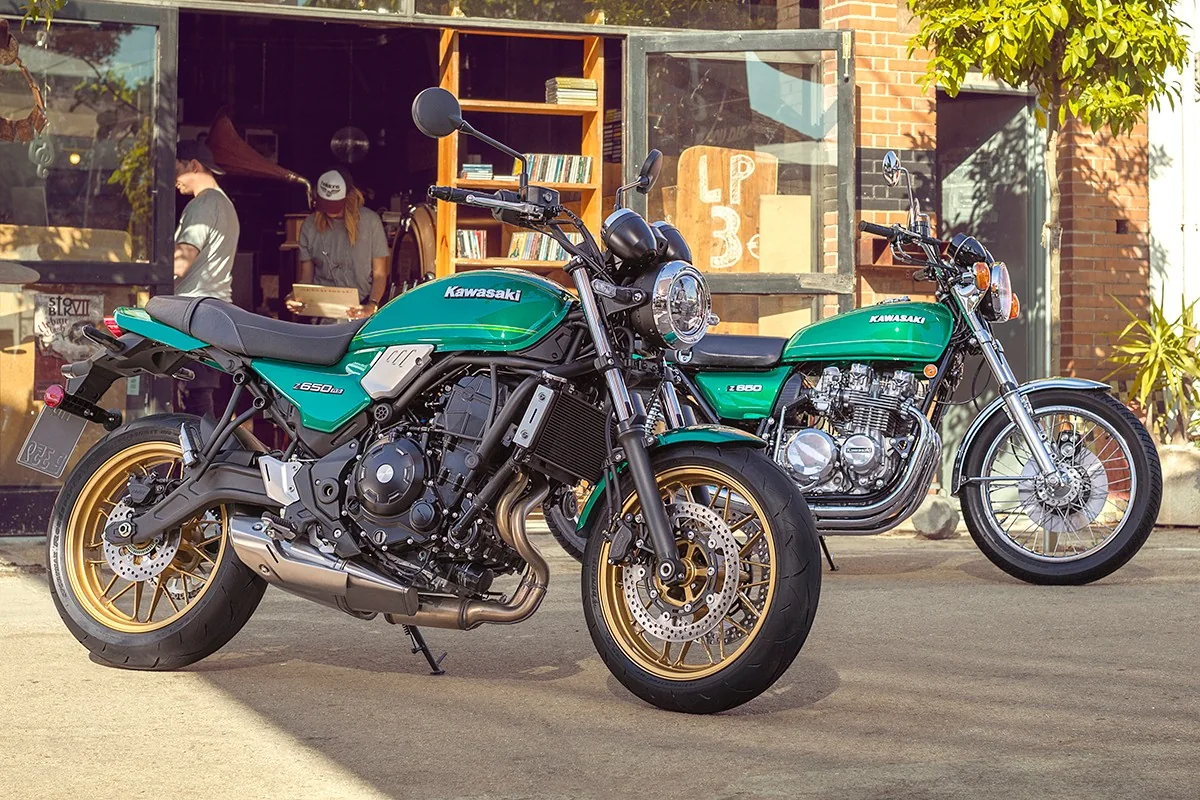
In 1976 Kawasaki launched the Z650, its third four-cylinder sports bike after the 903cc Z1 and the 750cc Z2. It was a smaller, lighter, more agile machine than the Z1, and riders nicknamed it the Zapper for the way it cut through traffic. In 2017 Kawasaki revived the Z1’s look for the Z900RS. In 2021 it did the same for the Z650, showing the Z650RS that went on sale as a 2022 model.
The important difference is under the tank. The original Z650 was an inline four. The Z650RS uses the parallel twin from the modern Z650 naked and Ninja 650. So the RS is not a remake of the old bike; it is a modern twin wearing the old bike’s clothes, as the Webike history put it, in the same way the Z900RS relates to the Z1.
Classic Motorcycle Mechanics rode the two back to back in 2024. The original made 66 hp at 8,500 rpm, weighed about 220 kg, had a five-speed gearbox, a single 275 mm front disc and a rear drum brake. The RS makes a similar 67 hp but about 12 percent more torque, weighs 187 kg, has six gears and twin front discs. The magazine found the RS pulls harder through the revs and stops far better, with the original’s brakes its biggest weakness, while the old four is smoother at the top and draws far more attention. Its conclusion was that the two complement each other rather than compete: the RS is for riders who want the look without the classic ownership.
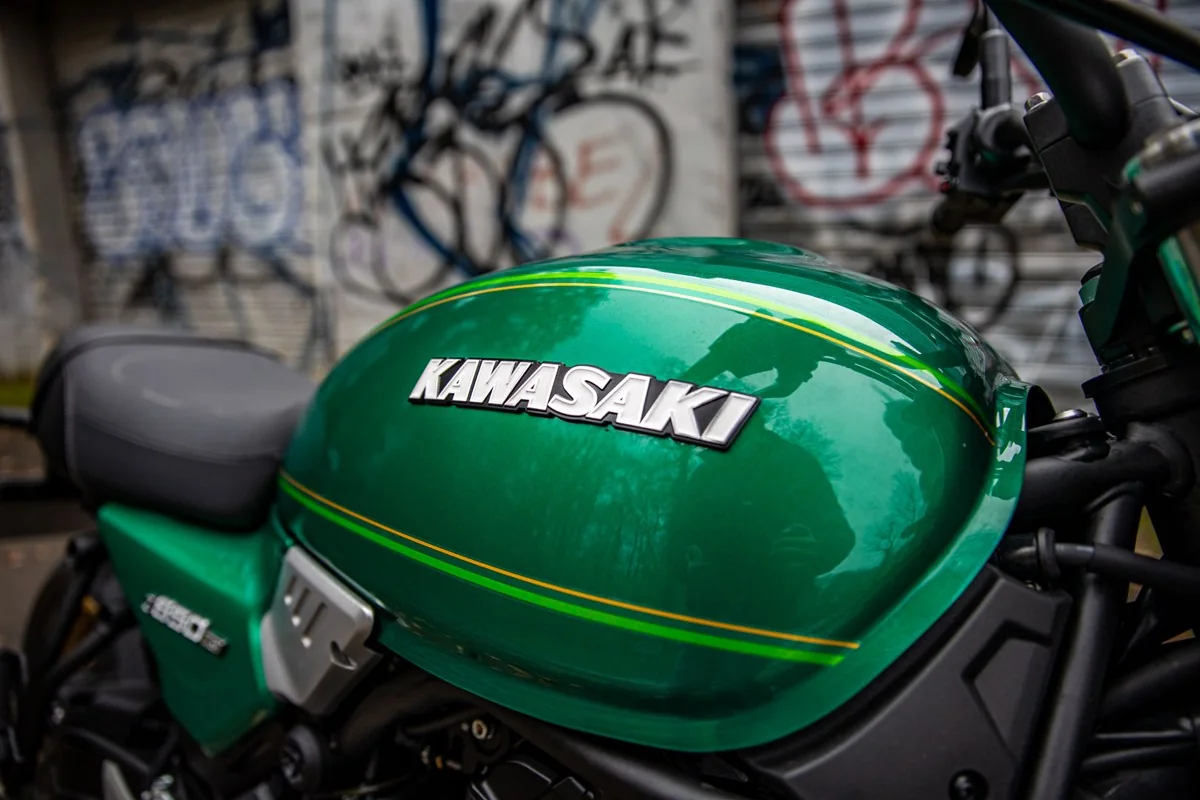
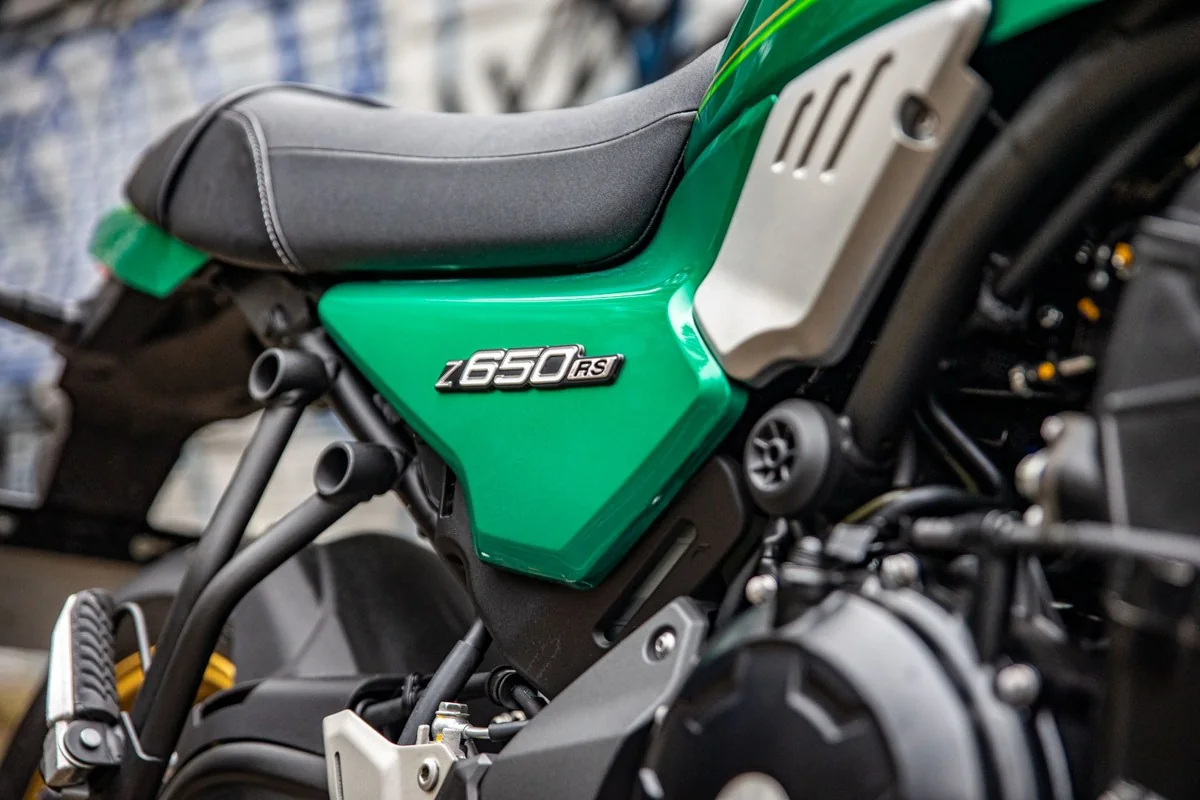
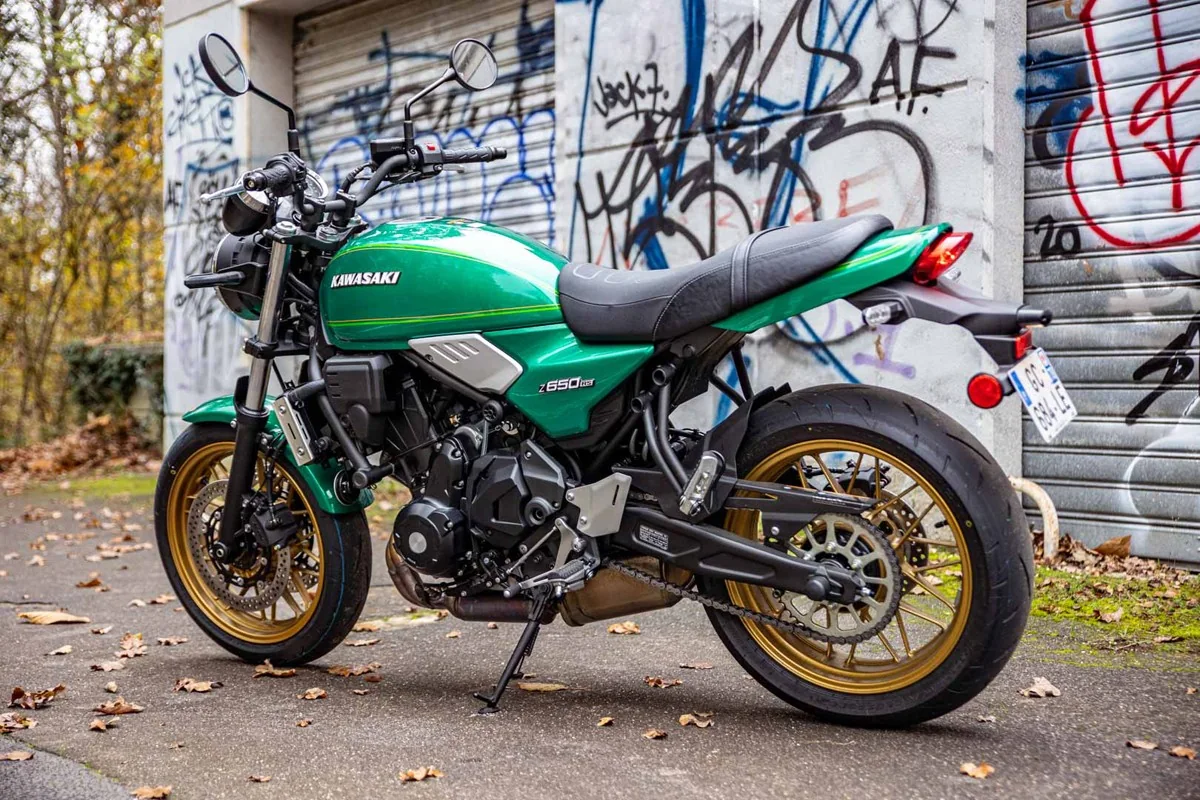
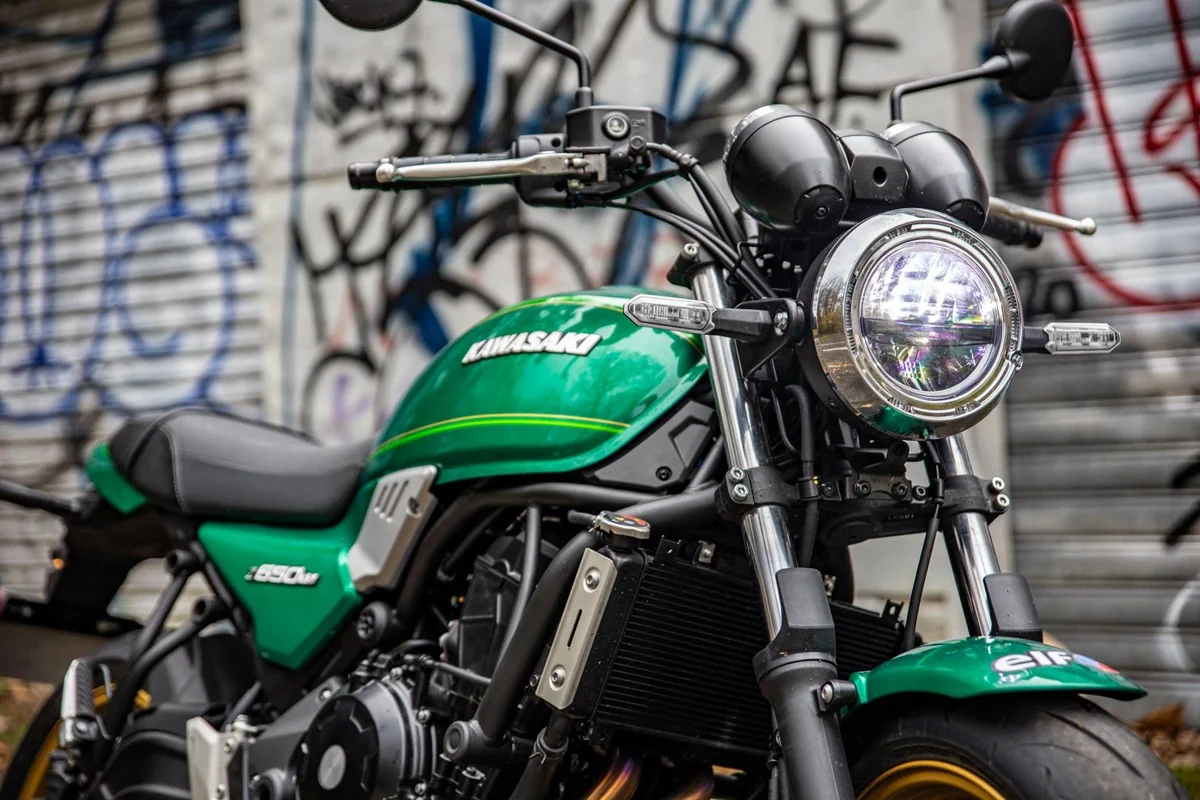
The styling borrows heavily from the 1976 bike: a teardrop tank with pinstripes, a round LED headlight in a chrome-rimmed shell, twin analogue clocks, a ducktail rear with a round tail light, side panels with a Z650RS badge, and cast wheels with flat, spoke-style arms finished in gold on the green bike. Kawasaki calls the look Retrovolution.
Which Z650RS is on sale in South Africa
This matters if you are buying new. Kawasaki South Africa’s current listing is the 2023 model, in Candy Emerald Green only, on a specification sheet that lists 50.2 kW, 64 Nm, 187 kg, an 800 mm seat and 4.3 litres per 100 km. It does not mention traction control.
The current European and American bikes have two-mode Kawasaki Traction Control (KTRC) that can also be switched off, alongside the assist and slipper clutch and ABS. The 2027 model, which Gear Patrol covered in September 2026, changes only colours: Metallic Ocean Blue with a gold stripe and gold wheels, an all-black Ebony and Metallic Spark Black, and the returning Ebony with red accents. The engine and chassis are unchanged.
So the choice for a South African buyer is a discounted 2023 bike now, or waiting for Kawasaki South Africa to bring in a later model with traction control at what will probably be a higher price. Ask the dealer whether the bike on the floor has KTRC, and confirm in writing what warranty applies to 2023 stock.
The 649cc parallel twin
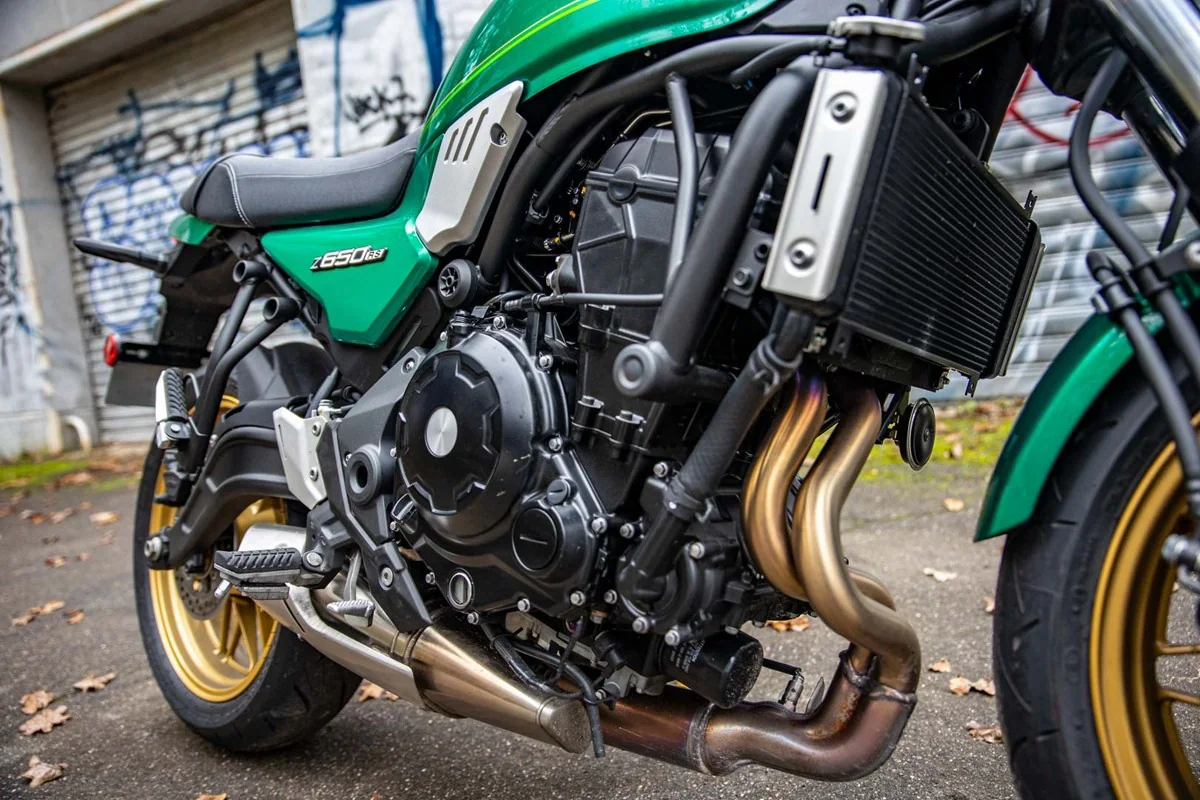
The engine is the one Kawasaki has refined for more than a decade in the Ninja 650 and Z650: a liquid-cooled, double overhead camshaft parallel twin with four valves per cylinder, an 83.0 mm bore and 60.0 mm stroke, a 10.8:1 compression ratio and two 36 mm throttle bodies. ZA Bikers noted at the launch that it is not retuned for the RS and keeps the Z650’s gear ratios. Kawasaki quotes 50.2 kW (68 PS) at 8,000 rpm and 64 Nm at 6,700 rpm. The exhaust is a two-into-one with the silencer tucked under the engine, which Kawasaki’s UK dealer material credits with a smoother, more usable delivery.
Kawasaki South Africa’s Philippe Guillaume found it less rough at low revs than the older ER-6 twin it descends from, happy to cruise at low revs in the higher gears, and properly usable from about 4,000 rpm. There is no ride-by-wire throttle and no riding modes, and he did not miss them. Classic Motorcycle Mechanics described it as flexible from low revs and pulling harder through the range than the original four, which needs revs to give its best. Billy’s Bikes described it as relatively lightweight at 187 kg.
The assist and slipper clutch makes the lever light and stops the rear wheel hopping on hard downshifts, which helps newer riders. The six-speed gearbox is shared with the Z650. Service intervals are 12,000 km or a year.
At altitude every naturally aspirated engine loses power, about 15 percent on the Highveld, so in Johannesburg or Pretoria you have roughly 43 kW. That is still plenty for a 187 kg bike in town and on the open road, and the twin’s torque spread hides the loss better than a peaky engine would.
Chassis, suspension and brakes
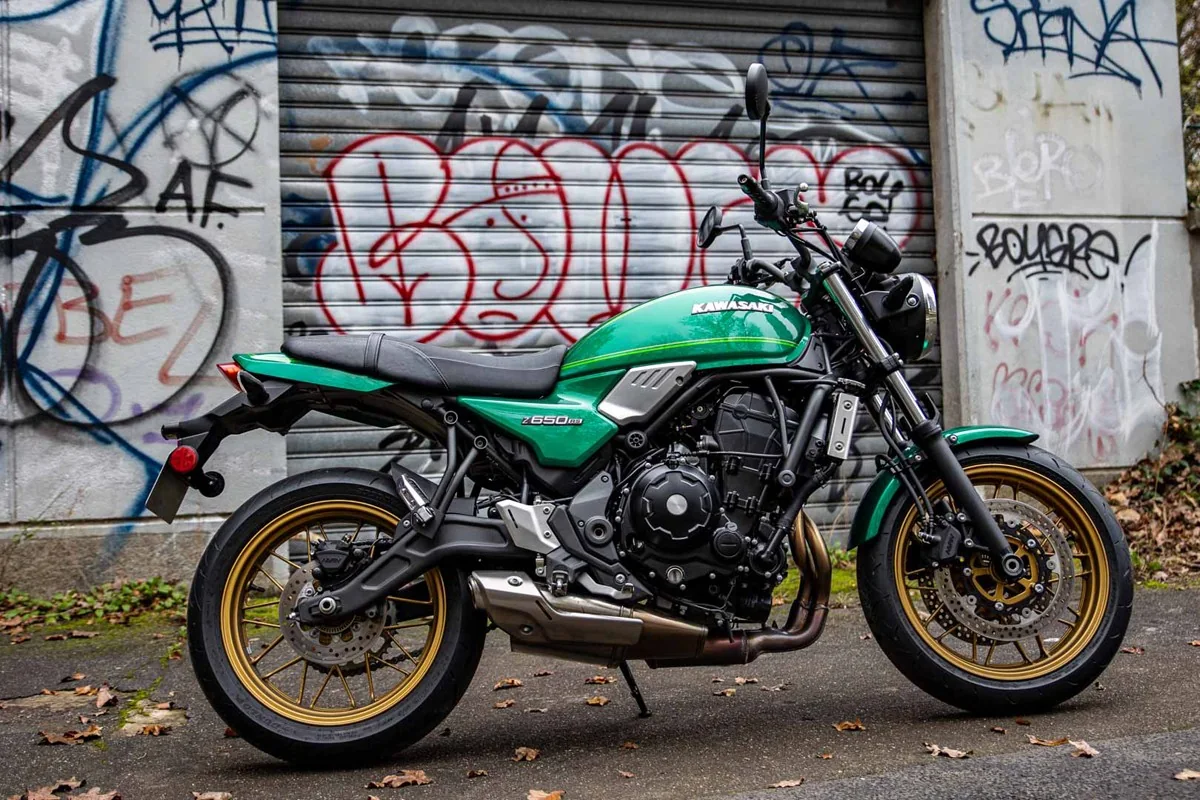
The chassis is the Z650’s: a high-tensile steel trellis frame with 24 degrees of rake, 100 mm of trail and a 1,405 mm wheelbase, all of which add up to quick, light steering. The 41 mm conventional fork has 125 mm of travel and no adjustment. The rear shock sits almost horizontally under the seat on a back-link, with 130 mm of travel and adjustable preload.
Brakes are twin 300 mm front discs with dual-piston calipers and a single 220 mm rear disc, with ABS. ZA Bikers noted the RS uses round discs where the Z650 has wave-shaped ones, to suit the retro look. The 17 inch cast wheels wear a 120/70 front and a 160/60 rear tyre. Guillaume called the brakes reliable rather than exciting, which is what you expect from twin-piston calipers; Classic Motorcycle Mechanics said the gap to the original’s single disc and drum was the biggest difference between the two bikes.
Ground clearance is 125 mm, which BikeDekho’s review flagged as low. That matters on South African speed humps and steep driveways more than in corners.
How it rides
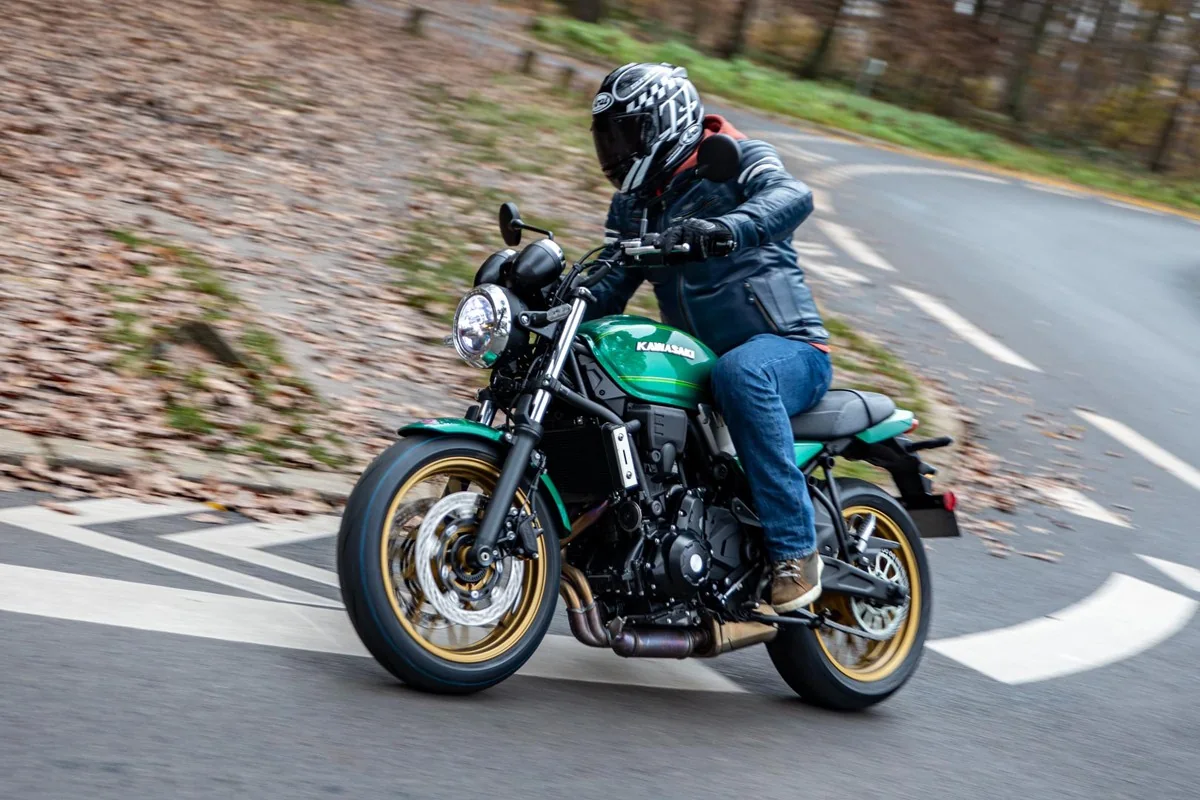
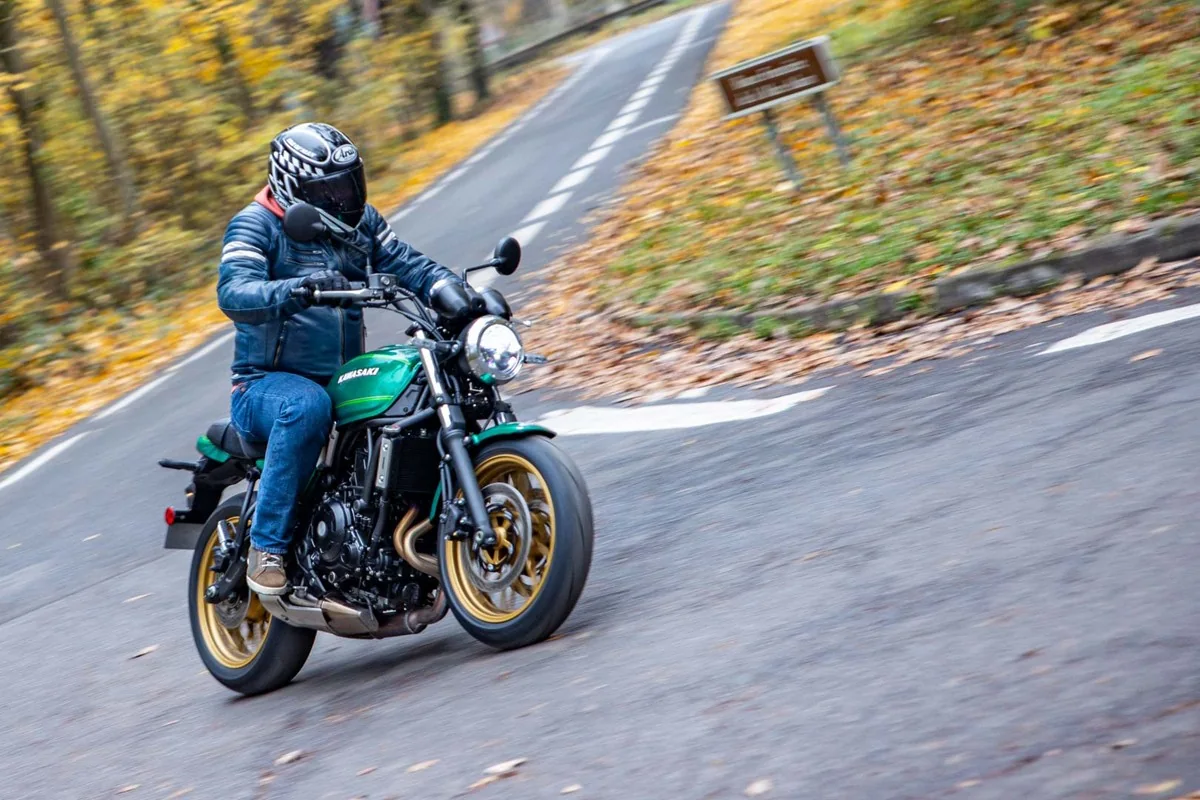
Guillaume described the handling as neutral yet lively, and the bike as light and easy at 187 kg. On twisty roads it changes direction quickly; on the highway the thick seat and soft suspension made several hundred kilometres manageable, though there is no wind protection at all. Classic Motorcycle Mechanics found it turns quickly and gives good feedback, where the heavier original turns slowly but feels planted.
The suspension is set up for comfort, which suits the bike’s purpose. This is not a sports bike in retro clothing. It is an easy, friendly motorcycle for commuting, weekend rides and riders stepping up from a 300 or 400. Gear Patrol called it appealing to beginners and experienced riders alike, and less demanding than the Z900RS.
Clocks, lights and electronics
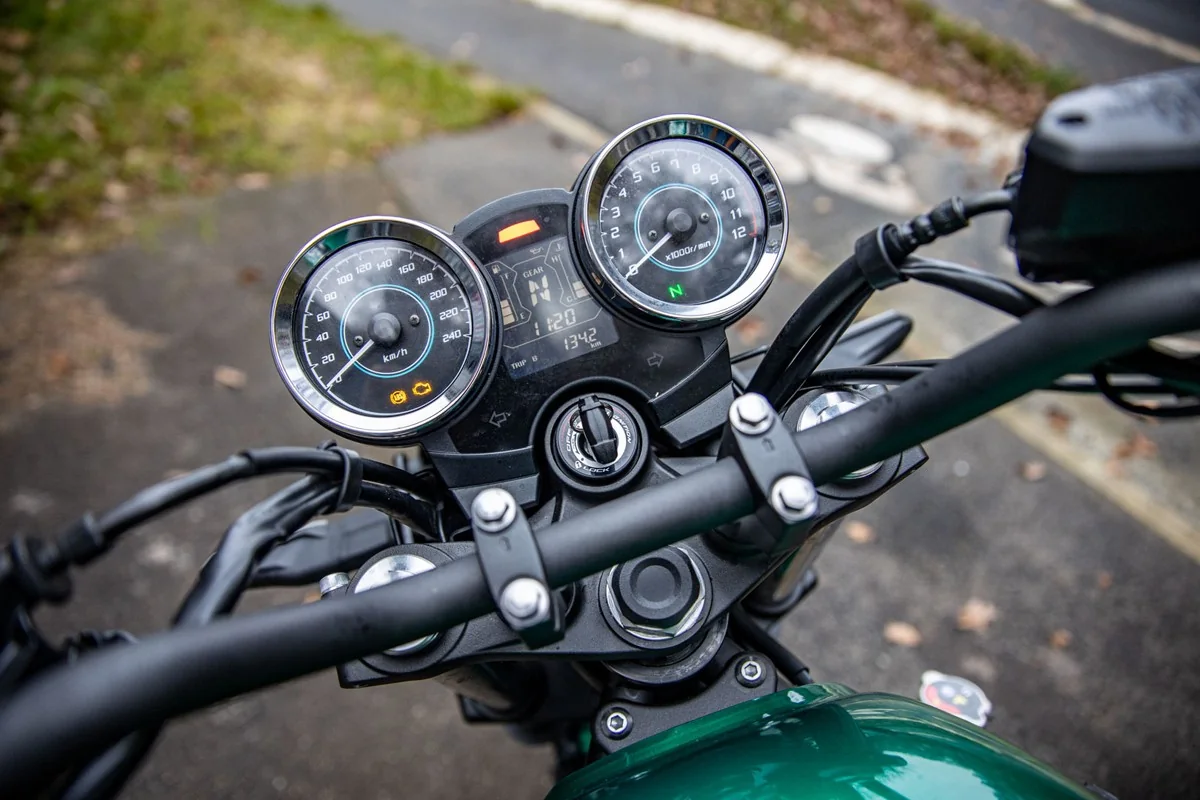
The instruments are two analogue dials, a speedometer and a rev counter with chrome bezels, either side of a small LCD showing the gear position, fuel level, trip meters, a clock and Kawasaki’s Economical Riding Indicator. All the lighting is LED: the round headlight, the slim indicators and the round tail light.
Electronics are deliberately simple. ABS is standard. The assist and slipper clutch is standard. Current European and American bikes add two-mode KTRC traction control that can be switched off; the 2023 South African specification does not list it. There are no riding modes, no cruise control, no TFT screen and no smartphone connectivity, and for a bike like this that is part of the point.
Seat height, ergonomics and comfort
Compared with the Z650 naked, Kawasaki raised the handlebar 50 mm and moved it 30 mm closer, with a top yoke 20 mm higher, for a more upright riding position. Kawasaki Europe gives the seat height as 820 mm with an optional 800 mm seat; Kawasaki South Africa’s sheet for the 2023 bike lists 800 mm. Either way it is low enough for most riders to put both feet down.
The seat is thick and well padded, and Guillaume rated it comfortable for long highway days. Classic Motorcycle Mechanics was more mixed: plush at first, but one rider found it uncomfortable after about 400 km in a day. Its testers also disliked the small pillion seat and grab rail, the awkward seat lock and the low number plate. Grab rails and a helmet lock are paid extras.
The real limit on touring is the 12 litre tank. Guillaume measured about 6 litres per 100 km at 130 km/h, which gives a range of roughly 200 km at that speed. At more relaxed speeds it uses far less.
Price and availability in South Africa
Kawasaki Motors South Africa lists the 2023 Z650RS in Candy Emerald Green at R169,990, with the earlier R174,995 struck through. A Billy’s Bikes test of the 2023 bike reported an even lower dealer price of R149,995 at the time, down from R175,000, so it pays to ask more than one dealer. When the bike was first shown in 2021, ZA Bikers noted that the Z650 naked then cost R122,995, which shows how far prices have moved since.
For comparison, the current model is £7,899 in Britain with a two-year unlimited-mileage warranty, $8,999 in the United States for 2027, and about ₹7.83 lakh in India. Kawasaki South Africa does not currently list the Z650 naked or the Z900RS, which leaves the Z650RS as its only retro and the cheaper alternative to its R219,995 Z900.
Kawasaki South Africa’s site does not state the warranty on the product page, so ask the dealer for it in writing, particularly on 2023 stock.
What it costs to run
Petrol is at a record. The October 2026 adjustment took inland 95 unleaded to about R30 a litre.
Kawasaki South Africa claims 4.3 litres per 100 km and Kawasaki Europe 4.4. Kawasaki South Africa’s own test measured about 6 at a steady 130 km/h. For mixed riding we have used 5.0 litres per 100 km.
- A full 12 litre tank costs about R360.
- Range is roughly 240 km, or about 200 km at highway speeds.
- Fuel costs about R1.50 a kilometre.
- A 40 km round-trip commute costs about R60 a day, or roughly R1,320 over 22 working days.
Service intervals are 12,000 km or a year. The 649cc twin is one of the most widely used engines Kawasaki makes, so parts and experienced workshops are easy to find. Budget for chain and sprockets and tyres in the usual way for a 50 kW bike.
Licence requirements
The Z650RS needs a full Code A motorcycle licence, available from the age of 18 after a learner’s licence and a driving test. South Africa has no restricted category for newer riders, so the 35 kW version Kawasaki sells for Europe’s A2 licence is not relevant here. The full-power bike is gentle enough that many riders move straight onto it from a 300 or 400. Our guide to what a motorbike licence costs in South Africa covers the fees and the tests.
Z650RS versus the alternatives
Prices below are from the importers and ZA Bikers in October 2026.
Royal Enfield Interceptor 650, Classic 650 and Bear 650
From R129,200, R127,000 and R138,700 respectively at Royal Enfield South Africa. Air and oil-cooled 648cc twins with about 35 kW, heavier and slower than the Kawasaki but cheaper and more authentically old-fashioned. The Interceptor is the closest in spirit; the Bear is a scrambler. If you want a 650 retro and budget comes first, these are where to start.
CFMoto 700CL-X Heritage
R145,900 at Bikeshop Rivonia, according to ZA Bikers. A 693cc twin with 55 kW, more power and a lower price than the Kawasaki. Kawasaki South Africa’s tester found it peakier and less smooth. Dealer coverage and resale are the trade-off.
Triumph Trident 660
About R180,000. A triple with more power and a sportier chassis, styled as a modern roadster rather than a 1970s one. Read our Trident 660 review.
Yamaha XSR900 and Kawasaki Z900
R219,950 and R219,995. The step up: a triple and a four with far more performance, at about R50,000 more. Our Kawasaki Z900 review covers the bigger Kawasaki.
Honda CB650R
The obvious Japanese rival elsewhere, and a four-cylinder, but Honda South Africa did not list it when we checked.
Browse the naked and retro bikes for sale on Scooter125 to see what else this budget buys.
Full specifications
Figures from Kawasaki Europe (2027 model) and Kawasaki Motors South Africa (2023 model). Where they differ, both are given.
| Engine | 649cc liquid-cooled DOHC 8-valve parallel twin |
| Bore x stroke | 83.0 x 60.0 mm |
| Compression ratio | 10.8:1 |
| Fuel system | Fuel injection, 2 x 36 mm throttle bodies |
| Power | 50.2 kW (68 PS) at 8,000 rpm |
| Torque | 64 Nm at 6,700 rpm |
| Gearbox | 6-speed, assist and slipper clutch, sealed chain |
| Frame | High-tensile steel trellis |
| Front suspension | 41 mm telescopic fork, 125 mm travel |
| Rear suspension | Horizontal back-link, preload adjustable, 130 mm travel |
| Front brakes | Twin 300 mm discs, dual-piston calipers, ABS |
| Rear brake | 220 mm disc, single-piston caliper, ABS |
| Wheels and tyres | 17 inch spoke-style cast; 120/70 ZR17 front, 160/60 ZR17 rear |
| Rake and trail | 24.0 degrees, 100 mm |
| Wheelbase | 1,405 mm |
| Length x width x height | 2,065 x 800 x 1,115 mm |
| Ground clearance | 125 mm |
| Seat height | 820 mm (800 mm low seat) per Kawasaki Europe; 800 mm per Kawasaki South Africa |
| Kerb weight | 187 kg |
| Fuel tank | 12 litres |
| Claimed consumption | 4.3 litres per 100 km (Kawasaki SA); 4.4 (Kawasaki Europe) |
| Electronics | ABS; 2-mode KTRC traction control on current European and US models, not listed for the 2023 SA bike |
| Instruments | Twin analogue dials with multi-function LCD |
| South African price | R169,990 (2023 model, Candy Emerald Green, reduced from R174,995) |
Frequently asked questions
How much is the Kawasaki Z650RS in South Africa?
Kawasaki Motors South Africa lists the 2023 Z650RS at R169,990, reduced from R174,995. It is offered in Candy Emerald Green.
How much power does the Z650RS make?
50.2 kW (68 PS) at 8,000 rpm and 64 Nm at 6,700 rpm, from a 649cc liquid-cooled parallel twin. Expect about 15 percent less on the Highveld.
Is the Z650RS a four-cylinder like the original Z650?
No. The 1976 Z650 was an inline four. The Z650RS uses the parallel twin from the modern Z650 and Ninja 650.
Does the Z650RS have traction control?
Current European and American models have two-mode KTRC traction control that can be switched off. Kawasaki South Africa’s 2023 specification does not list it, so check with the dealer.
What is the seat height of the Z650RS?
Kawasaki Europe quotes 820 mm, with an optional 800 mm seat. Kawasaki South Africa’s 2023 sheet lists 800 mm.
Is the Z650RS good for beginners?
Yes. It is light at 187 kg, has a low seat, an assist and slipper clutch, ABS and smooth, predictable power. It needs a full Code A licence.
How far can the Z650RS go on a tank?
About 240 km in mixed riding from its 12 litre tank, or roughly 200 km at a steady 130 km/h.
What is the difference between the Z650RS and the Z900RS?
The Z900RS is styled on the 1972 Z1 and uses a 948cc four-cylinder. The Z650RS is lighter, cheaper and less demanding, with a 649cc twin. Kawasaki South Africa currently lists only the Z650RS.
The verdict
The Z650RS does one thing very well. It takes a proven, friendly, economical engine and a light, easy chassis, and wraps them in some of the best retro styling on sale, with a teardrop tank, gold wheels and twin clocks that look right from every angle. It is not fast and it is not a tourer, but every tester found it easy, comfortable and enjoyable, and the original it copies cannot match its brakes, weight or reliability.
At R169,990 for the discounted 2023 model it sits between the Royal Enfield 650s, which are cheaper and more old-fashioned, and the bigger triples and fours at about R220,000. The questions to settle with the dealer are traction control, which the 2023 bike does not list, and warranty on older stock. If those answers satisfy you, it is one of the easiest motorcycles to live with in its class.
Compare it with the naked and retro bikes for sale on Scooter125 before you decide.
Sources referenced
- Kawasaki Motors South Africa, Z650RS 2023 product page and specification sheet: price, colour and specification
- Kawasaki South Africa, Philippe Guillaume, “First Ride: The New Kawasaki Z650RS Modern Classic”, 20 January 2022
- Kawasaki Europe, Z650RS 2027 model page: specification and colours
- Kawasaki USA, Z650RS model page: 2027 price and features
- Classic Motorcycle Mechanics, Bertie Simmonds, “Twins: real vs retro”, 8 February 2024
- ZA Bikers, “The Kawasaki Z650RS: Big Green’s new retro middleweight is here”, 29 September 2021
- Gear Patrol, Steve Mazzucchi, “2027 Kawasaki Z650RS”, 8 September 2026, updated 19 October 2026
- Billy’s Bikes, 2023 Kawasaki Z650RS test
- Seastar Superbikes (UK), Z650RS model page: UK price, warranty and specification
- BikeDekho, Kawasaki Z650RS: Indian price and expert review
- Webike, “A journey through time: from Z1 to modern classic Kawasaki Z650RS custom by ACTIVE”, 18 November 2025
- Modern Classic Motorcycle News, Frank Duggan, “Kawasaki Z650RS walk-around (2026)”, 5 August 2026
- Royal Enfield South Africa, Interceptor 650, Classic 650 and Bear 650 prices; ZA Bikers prices for the CFMoto 700CL-X Heritage and Yamaha XSR900
- Department of Mineral and Petroleum Resources, October 2026 fuel price adjustment